


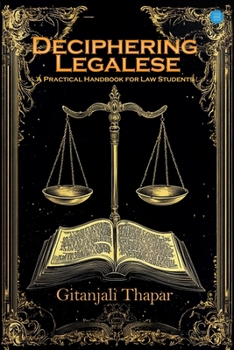
Deciphering Legalese: A Practical Handbook for Law Students

Language is the lifeblood of law. Judgments, and legal opinions rests upon precision, clarity and most decisively on the merit of words. Legalese is a distinct mode of communication and a technical tool with its own conventions, vocabulary and reasoning patterns. The present book 'Deciphering Legal Language: A Practical Handbook for Law Students' explores the nature, function, lexicon, structure and syntax of legal language that accords the legal discourse its distinctive character. Drawing on examples from legislation, case laws and legal drafting practices, the book aims to decipher legal language and reveals how words act as lawyers' tool in determining and interpreting law and justice. As a handbook of information for law students it offers a practical insight into the nuances of legalese. The book aims to engage and encourage the readers and the budding lawyers to use legal language in a more refined and enduring way.
Customer Reviews
ThriftBooks ® and the ThriftBooks ® logo are registered trademarks of Thrift Books Global, LLC
