


Decentra: An EXIT, Not a Revolution: For anyone who suspects this isn't FREEDOM

Decentra is a conceptual framework that examines how individuals may recover personal agency within increasingly centralized social, economic, and technological systems. Drawing from systems theory, behavioral economics, historical case analysis, and symbolic structure, the work proposes decentralization not as a political program but as a personal methodology.
Rather than advocating withdrawal or opposition, Decentra explores adaptive strategies that allow individuals to operate effectively inside complex systems while reducing dependency, cognitive capture, and asymmetrical exposure to risk. Central to the book is the idea that autonomy is not a fixed state but a dynamic equilibrium maintained through attention management, ritualized decision-making, and structural simplification.
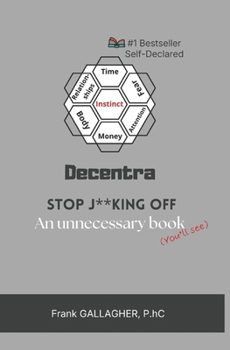
The book introduces a formalized symbolic model-the Decentra Hex-used as both an analytical and practical tool. This model allows readers to evaluate constraints such as time, energy, debt, and fear, not in isolation, but as interdependent forces shaping behavior. Through historical parallels, including industrial transitions and labor reconfiguration, the text demonstrates how decentralization has repeatedly emerged as a survival response rather than an ideological stance.
Written in a restrained academic tone, Decentra avoids prescriptive moral claims. Instead, it offers a stable conceptual architecture for readers seeking to live with greater internal coherence in environments defined by acceleration, abstraction, and systemic pressure. The work positions decentralization as a quiet, personal discipline-measured, repeatable, and grounded in lived reality.
Related Subjects
PsychologyCustomer Reviews
ThriftBooks ® and the ThriftBooks ® logo are registered trademarks of Thrift Books Global, LLC
