


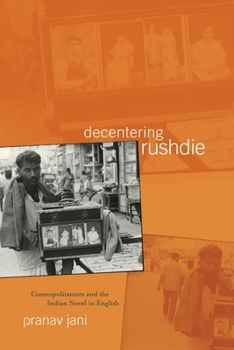
Decentering Rushdie: Cosmopolitanism and the Indian Novel in English
No Customer Reviews

Select Format
Select Condition 
Book Overview
Interrogating current theories of cosmopolitanism, nationalism, and aesthetics in Postcolonial Studies, Decentering Rushdie offers a new perspective on the Indian novel in English. Since Salman Rushdie's Midnight's Children won the Booker Prize in 1981, its postmodern style and postnational politics have dominated discussions of postcolonial literature. As a result, the rich variety of narrative forms and perspectives on the nation that constitute the field have been obscured, if not erased altogether.
Reading a range of novels published between the 1950s and 1990s, including works by Nayantara Sahgal, Kamala Markandaya, Anita Desai, and Arundhati Roy, Decentering Rushdie suggests an alternative understanding of the genre in postcolonial India. Pranav Jani documents the broad shift from nation-oriented to postnationalist perspectives following the watershed crisis of the Emergency of the 1970s. Recovering the "namak-halaal cosmopolitanism" of early novels-a cosmopolitanism that is "true to its salt"-Decentering Rushdie also explains the rise and critical celebration of postnational cosmopolitanism.Decentering Rushdie thus resituates contemporary literature within a nuanced history of Indian debates about cosmopolitanism and the national question. In the process, Jani articulates definitions of cosmopolitanism and nationalism that speak to the complex negotiation of language, culture, and representation in postcolonial South Asia.
Format:Paperback
Language:English
ISBN:0814257305
ISBN13:9780814257302
Release Date:October 2020
Publisher:Ohio State University Press
Length:288 Pages
Weight:0.94 lbs.
Dimensions:0.7" x 6.0" x 9.0"
Customer Reviews
0 rating
Copyright © 2026 Thriftbooks.com Terms of Use
| Privacy Policy | Do Not
Sell/Share My Personal Information | Cookie Policy | Cookie Preferences | Accessibility Statement
ThriftBooks® and the ThriftBooks® logo are registered trademarks of Thrift Books Global, LLC
ThriftBooks® and the ThriftBooks® logo are registered trademarks of Thrift Books Global, LLC
