


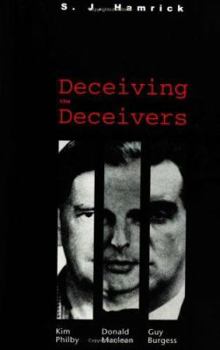
Deceiving the Deceivers: Kim Philby, Donald Maclean and Guy Burgess


Select Format
Select Condition 
Book Overview
Among the more sensational espionage cases of the Cold War were those of Moscow's three British spies--Kim Philby, Donald Maclean, and Guy Burgess. In this riveting book, S. J. Hamrick draws on... This description may be from another edition of this product.
Format:Hardcover
Language:English
ISBN:0300104162
ISBN13:9780300104165
Release Date:November 2004
Publisher:Yale University Press
Length:320 Pages
Weight:1.30 lbs.
Dimensions:9.5" x 0.8" x 6.5"
Related Subjects
Biographies England Espionage Ethnic & National Europe Historical History Intelligence & Espionage Ireland IrishCustomer Reviews
3 ratings
A shapeless mess, but sweeps all before it
Published by Thriftbooks.com User , 19 years ago
Good material and critical thinking, poorly arranged. The author has one basic point, which he reiterates in each chapter as either conclusion or thesis (sometimes both). And that point is, the British security services succeeded brilliantly for a half-century in misleading the public about the Burgess-Maclean-Philby case. To break it down to its most salient arguments: 1) Burgess and Maclean did not "jump" when they took that night boat to St-Malo in May 1951. They were "pushed"--by MI5. MI5 had been watching them for years, playing with Maclean as a cat plays with a mouse, delaying overt investigation while gradually inciting a sense of panic throughout the spy ring. 2) Kim Philby was neither head boy nor master spy. He was a bibulous blowhard, a second-rater whose utility to the Soviets expired long before 1951. When he was stationed at the embassy in Washington, DC in 1949-51, he did not even have a regular Soviet contact. (When he finally ended up in Moscow, the KGB had no use for him: he was under constant surveillance and suspicion.) Philby was mainly useful to the British security services, first as a useful fool whose contacts could be monitored, later as a straw-man who could be portrayed as a sort of Prof. Moriarty of espionage, thereby allowing the security services to hide how they much they actually knew about the Soviet apparatus. The arguments are based on the author's review of the so-called Venona transcripts, decryptions and counterintelligence documents that accumulated in the American security services from the 1940s and 50s. This book serves as a sort of bibliographic introduction to what can be pulled out of those files, but it is itself too confused and sprawling to be the final word itself. The thing is just difficult to read. It needed an editor and proofreader, to give it clarity and shape, and to catch the author's more obvious errors. At least twice Hamrick speaks of Heath being Prime Minister in 1963, and I can't tell whether he really means Macmillan or Lord Home, or means minister Heath in the cabinet.
A New Twist to an Old Story?
Published by Thriftbooks.com User , 21 years ago
For those who would be interested, my review of this book was published by H-Diplo, H-Net Reviews (H-Diplo@h-net.msu.edu) in February 2005. URL: http://www.h-net.org/reviews/showrev.cgi?path=170151117221847
Ex U.S. Envoy Questions Philby Legend
Published by Thriftbooks.com User , 21 years ago
S.J. Hamrick's study of an associated trio among the most infamous British 20th Century spies is a major step forward in Cold War history. He starts what may become the cracking of the myth surrounding Harold A. R. (Kim) Philby, the Soviet agent many blame for failures of several paramilitary operations the West mounted within the Soviet empire. Unfortunately, Hamrick offers little hard evidence to back up his attack on this outsized mythical spy. But the author is also able to turn that lack of evidence into the basis of his assault on Philby's storification. Much of the Philby legend was created by the subject spy himself in his book, "My Secret War". In the mid-1980s, British journalist Lord Nicholas Bethell added to the Philby legend by giving the Cambridge University-educated double agent credit as the main reason a British-American paramilitary operation in Albania failed. Bethell offered little or no evidence besides Philby's book, some comments from retired intelligence officers, and lots of airy speculation that Philby must have been to blame. Hamrick correctly offers a timeline that shows how unlikely that Bethell's thesis was accurate. "It is impossible to believe Philby had the means for any timely disclosure of OPC (a U.S. psychological warfare agency overseen by the CIA, State Department and military) individual operational plans or that he would even have found it necessary," he wrote. Hamrick echos other observers and participants - British and American - who view the Albanian projects as carrying the weight of their own ultimate failure in the "futility of their numbers and purpose". There were too few bravely enthusiastic, but naive, Albanian mountaineers sent home by air, land and sea to overthrow a nasty Communist regime whose internal security forces were trained by the Soviet NKVD. Two storm flags must be raised about the Hamrick work. One is the theory he postulates that the U.S. and British militaries used Philby as a conduit to pass disinformation to the Soviets. Thin evidence is the problem. The second is Hamrick's apparent failure to consult several works that contained major materiel germane to the Philby-Albania case, such as those by Burton Hersh, C.L. Sulzberger, Noel Malcolm and Enver Hoxha. He writes about the oft-criticized CIA counterspy James J. Angleton and the Office of Special Operations, a CIA branch that competed with the OPC for foreign agents and resources. But he also misses the most successful Western infiltration of Albania by agents sponsored by the CIA/OSO and Italian Naval Intelligence.
Copyright © 2026 Thriftbooks.com
Terms of Use | Privacy Policy | Do Not Sell/Share My Personal Information | Cookie Policy | Cookie Preferences | Accessibility Statement
ThriftBooks ® and the ThriftBooks ® logo are registered trademarks of Thrift Books Global, LLC
ThriftBooks ® and the ThriftBooks ® logo are registered trademarks of Thrift Books Global, LLC
