


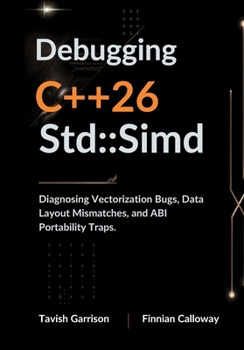
Debugging C++26 Std::Simd: Diagnosing Vectorization Bugs, Data Layout Mismatches, and ABI Portability Traps. (The C++ Field Guide Series)
No Customer Reviews

A loop that "should vectorize" can run at scalar speed for months before anyone checks the assembly, and the benchmark that finally catches it will point at the wrong line.
Most engineers treat a clean compile and a passing benchmark as proof that std:: simd code is doing what it looks like it's doing. It rarely is. Auto-vectorization backs off silently when a compiler's cost model decides against it. An array of structures defeats every vector load the moment a struct's fields sit between the ones you actually want. A native_simd type resolved against one build's flags produces a binary contract that a second, differently-flagged build silently disagrees with, and the result isn't a crash, it's a number that's subtly wrong in a way that looks like a numerical bug rather than a layout one.
Debugging C++26 Std:: Simd is not an introduction to SIMD or to the standard library. It is a strictly technical, mechanism first field guide for systems engineers, quant developers, and performance engineers who already write vectorized C++ and need to diagnose, not guess at, why their std:: simd code isn't vectorizing, isn't portable, or isn't as fast as the type signature implies.
Through precise ABI reasoning, production grade code, and real compiler diagnostics, you will learn to confirm what your code actually compiled to instead of what it should have compiled to, and to catch a layout or width mismatch before it ships instead of after a customer reports it.
Inside the Book, You Will Diagnose and Fix:
Silent Scalar Fallback: Read compiler vectorization reports and generated assembly to confirm whether a loop actually vectorized, instead of inferring it from clean source code and a fast-looking benchmark.
Data Layout Mismatches: Recognize the exact array of structures pattern that forces a gather the vectorizer's cost model will reject, and restructure into structure of arrays or AoSoA matched to your real access pattern.
ABI Portability Traps: Stop treating native_simd as a portable type, and know exactly when a fixed width crossing a shared library, plugin, or serialized boundary is a correctness requirement, not a performance choice.
Masking and Predication Bugs: Reason precisely about what where actually executes on masked out lanes, and catch the division by zero and wasted computation that a scalar if habit smuggles into vectorized code.
Horizontal Operation Costs: Identify a reduction hiding inside a hot loop instead of after it, and understand why cross lane operations cost real, measurable work that lane wise arithmetic never pays.
Benchmarking That Isolates the Real Variable: Build a configuration matrix that separates a layout gain from a vectorization gain, so a cited speedup means something six months and one compiler upgrade later.
Stop trusting a fast-looking benchmark or a struct that "should" vectorize as proof your std:: simd code is doing real work. Whether you're auditing an inherited numerical hot path or writing a new one from scratch, this book gives you the exact reasoning, code, and diagnostic flow to know the difference between vectorized and merely compiled.
Who this book is for: senior C++ engineers, quant and trading systems developers, and performance or platform engineers who already write vectorized or numerically intensive C++ and need to move from "it compiled and benchmarked fine" to actually diagnosing and verifying vectorization, layout, and ABI correctness. It assumes working knowledge of C++ and SIMD fundamentals. It is not an introduction to vectorization for beginners.
Scroll up and click "Buy Now" to diagnose your vectorization bugs before a customer's hardware finds them for you.
Most engineers treat a clean compile and a passing benchmark as proof that std:: simd code is doing what it looks like it's doing. It rarely is. Auto-vectorization backs off silently when a compiler's cost model decides against it. An array of structures defeats every vector load the moment a struct's fields sit between the ones you actually want. A native_simd type resolved against one build's flags produces a binary contract that a second, differently-flagged build silently disagrees with, and the result isn't a crash, it's a number that's subtly wrong in a way that looks like a numerical bug rather than a layout one.
Debugging C++26 Std:: Simd is not an introduction to SIMD or to the standard library. It is a strictly technical, mechanism first field guide for systems engineers, quant developers, and performance engineers who already write vectorized C++ and need to diagnose, not guess at, why their std:: simd code isn't vectorizing, isn't portable, or isn't as fast as the type signature implies.
Through precise ABI reasoning, production grade code, and real compiler diagnostics, you will learn to confirm what your code actually compiled to instead of what it should have compiled to, and to catch a layout or width mismatch before it ships instead of after a customer reports it.
Inside the Book, You Will Diagnose and Fix:
Silent Scalar Fallback: Read compiler vectorization reports and generated assembly to confirm whether a loop actually vectorized, instead of inferring it from clean source code and a fast-looking benchmark.
Data Layout Mismatches: Recognize the exact array of structures pattern that forces a gather the vectorizer's cost model will reject, and restructure into structure of arrays or AoSoA matched to your real access pattern.
ABI Portability Traps: Stop treating native_simd as a portable type, and know exactly when a fixed width crossing a shared library, plugin, or serialized boundary is a correctness requirement, not a performance choice.
Masking and Predication Bugs: Reason precisely about what where actually executes on masked out lanes, and catch the division by zero and wasted computation that a scalar if habit smuggles into vectorized code.
Horizontal Operation Costs: Identify a reduction hiding inside a hot loop instead of after it, and understand why cross lane operations cost real, measurable work that lane wise arithmetic never pays.
Benchmarking That Isolates the Real Variable: Build a configuration matrix that separates a layout gain from a vectorization gain, so a cited speedup means something six months and one compiler upgrade later.
Stop trusting a fast-looking benchmark or a struct that "should" vectorize as proof your std:: simd code is doing real work. Whether you're auditing an inherited numerical hot path or writing a new one from scratch, this book gives you the exact reasoning, code, and diagnostic flow to know the difference between vectorized and merely compiled.
Who this book is for: senior C++ engineers, quant and trading systems developers, and performance or platform engineers who already write vectorized or numerically intensive C++ and need to move from "it compiled and benchmarked fine" to actually diagnosing and verifying vectorization, layout, and ABI correctness. It assumes working knowledge of C++ and SIMD fundamentals. It is not an introduction to vectorization for beginners.
Scroll up and click "Buy Now" to diagnose your vectorization bugs before a customer's hardware finds them for you.
Format:Paperback
Language:English
ISBN:B0HGHYS6QV
ISBN13:9798194850457
Release Date:August 2026
Publisher:Independently published
Length:150 Pages
Weight:0.56 lbs.
Dimensions:9.6" x 0.3" x 6.7"
Customer Reviews
0 rating
Copyright © 2026 Thriftbooks.com
Terms of Use | Privacy Policy | Do Not Sell/Share My Personal Information | Cookie Policy | Cookie Preferences | Accessibility Statement
ThriftBooks ® and the ThriftBooks ® logo are registered trademarks of Thrift Books Global, LLC
ThriftBooks ® and the ThriftBooks ® logo are registered trademarks of Thrift Books Global, LLC
