


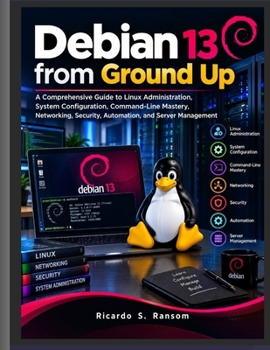
Debian 13 from Ground Up: A Comprehensive Guide to Linux Administration, System Configuration, Command-Line Mastery, Networking, Security, Automation,

Have you ever opened a terminal, stared at a blinking cursor, and wondered if you were actually in control of your own computer? If you have, this book was written for you.
Linux administration has a reputation for being intimidating, something reserved for people who already speak in commands and configuration files. But here's the truth: every confident system administrator started exactly where you are now, unsure which command did what, nervous about typing something that might break everything. The difference between them and you is that they kept going, one concept at a time, until it stopped feeling like a foreign language.
This book is built to take you through that exact journey, using one of the most respected and widely trusted operating systems in the world as your training ground. Why does that matter? Because the skills you build here aren't theoretical. They're the same skills running behind countless web servers, cloud deployments, and enterprise infrastructures across the globe. When you learn this, you're not learning a toy version of system administration. You're learning the real thing.
So what will you actually walk away with?
You'll start at the beginning, installing the operating system itself, whether on a virtual machine, a spare laptop, or a cloud server, and understanding what's happening at each step rather than clicking through blindly. From there, you'll build real command-line fluency, not just memorized commands, but a genuine understanding of how the filesystem, permissions, and shell work together.
Curious about networking? You'll configure interfaces, troubleshoot connectivity, and understand the protocols that keep modern systems communicating. Worried about security? You'll learn to harden a server properly, from authentication and firewalls to intrusion detection, using the layered thinking that security professionals rely on every day.
Want to stop repeating the same manual tasks? You'll learn to automate your work using configuration management tools and scripting, turning hours of repetitive labor into reliable, repeatable code. And because modern infrastructure increasingly lives in containers and the cloud, you'll get a practical introduction to that world too, not just buzzwords, but working knowledge you can apply.
What makes this guide different from scattered tutorials online? Structure and depth. Each chapter builds on the last, so by the time you reach advanced material on performance tuning, disaster recovery, and infrastructure automation, you're not lost. You're ready, because the foundation underneath you is solid.
This book doesn't assume you're already technical. It assumes you're willing to learn, follow along, make mistakes in a safe environment, and build real understanding instead of surface-level familiarity. Every chapter includes practical, hands-on examples you can follow step by step, so you're never just reading about a concept; you're actually doing it.
Who is this for? Beginners taking their first real steps into system administration. IT professionals looking to formalize and deepen skills they've picked up informally. Developers who want to understand the infrastructure their applications run on. And anyone considering a career in DevOps, site reliability engineering, or cloud infrastructure, where this knowledge forms the baseline expectation.
By the final page, you won't just know commands. You'll understand systems, how they're built, how they fail, and how to keep them running reliably under real-world conditions. That's a different kind of confidence, the kind that comes from understanding what you're doing rather than blindly following steps.
If you're ready to stop feeling intimidated by the terminal and start feeling capable behind it, this is where that transformation begins.
Customer Reviews
ThriftBooks ® and the ThriftBooks ® logo are registered trademarks of Thrift Books Global, LLC
