


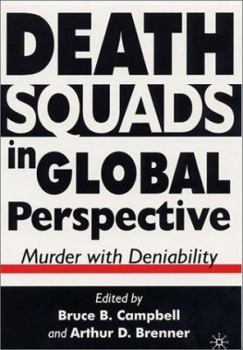
Death Squads in Global Perspective: Murder with Deniability


Select Format
Select Condition 
Book Overview
Death squads have become an increasingly common feature of the modern world. In nearly all instances, their establishment is tolerated, encouraged, or undertaken by the state itself, which thereby risks its monopoly on the use of force, one of the fundamental characteristics of modern states. Why do such a variety of regimes, under very different circumstances, condone such activity? Death Squads in Global Perspective hopes to answer that question and explain not only their development, but also why they can be expected to proliferate in the early 21st century.
Format:Paperback
Language:English
ISBN:1403960941
ISBN13:9781403960948
Release Date:October 2002
Publisher:Palgrave MacMillan
Length:364 Pages
Weight:0.10 lbs.
Dimensions:0.8" x 5.6" x 8.4"
Customer Reviews
1 rating
Death Squads Work!
Published by Thriftbooks.com User , 21 years ago
Like all books composed of essays from different authors, the quality varies, thus the 4 stars instead of 5 (actually a 4.5 seems the best rating.) Having said this, the end result of these depictions of "death sqauds," a term the authors have a difficult time agreeing on themselves, is that they work. Governments or individuals can employ contracted hit teams to intimidate, murder, rape or in general terrorize opponents with telling effect, all the while hiding behind a mask of feigned outrage. In India's case the tactic effectively neutralized seccessionist movements in Kashmir and the Punjab. While one can point to South Africa's even more exaggerated usage of such state terrorism and its subsequent failure to avoid apartheid's defeat, this book offers an intriguing rationale that one might overlook. Eventually the state apparatus achieved such omnipotence that it threatened the very entities it was designed to protect. Whether this had any effect on DeKlerk's eventual decision to decontruct the racist state is unclear, but certainly the ironic potential of the state terror consuming itself would not have dissuaded him from his historic path. The essay on Sebia's use of contracted ethnic cleansers is interesting because it does make plausible Miloisevic's denial of direct responsibility; all he did was arrange for local militias and imported Serb fighters to acquire the weapons they used to "ethnically cleanse". It becomes harder to make the case that he ordered specific cases of "genocide," a term that has been grossly misused for purely political and emotional reasons. However, the buck has to stop with the top dog (evidently not true with the Bush administration, though.) This is a good book. I was a little surprised that it left out Colombia, or Sri Lanka, countries that have active death squad activities, or even Northern Ireland. Maybe there will be a follow-up edition that will give wider scope to active insurgencies.
Copyright © 2025 Thriftbooks.com
Terms of Use | Privacy Policy | Do Not Sell/Share My Personal Information | Cookie Policy | Cookie Preferences | Accessibility Statement
ThriftBooks ® and the ThriftBooks ® logo are registered trademarks of Thrift Books Global, LLC
ThriftBooks ® and the ThriftBooks ® logo are registered trademarks of Thrift Books Global, LLC
