


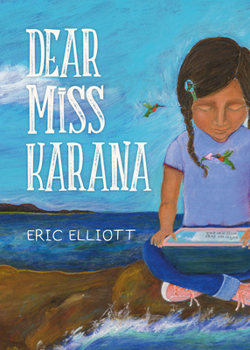
Dear Miss Karana

Select Format
Select Condition 
Book Overview
First written in Chamt eacute;ela and developed in accordance with fourth grade Common Core State Standards, Dear Miss Karana tells a compelling story of family, determination, and cultural perseverance.
While reading Island of the Blue Dolphins at school and learning about the real woman stranded on San Nicol aacute;s Island, ten-year-old T iacute;shmal begins writing emails to "Miss Karana" in hopes of talking to her spirit. When she arrived on the mainland of Southern California, Miss Karana spoke a language that no one could understand even back then, and all that remains is a recording of the song she sang when she was found on the island. T shmal realizes that some of the words sound very similar to Chamt ela (Luise ntilde;o), the language spoken on her reservation.
As she writes to Miss Karana, T shmal becomes more and more resolved to understand the lone woman's song. The only person able to help her is a grouchy great uncle, W h Pow eya ("two tongues"), the last living person fluent in the language of their ancestors from the belly button of the ocean: the islands including San Nicol s. Together, T shmal and W h Pow eya must discover what the lone woman said long ago in order to help her spirit finish the journey West.
Customer Reviews
ThriftBooks ® and the ThriftBooks ® logo are registered trademarks of Thrift Books Global, LLC
