


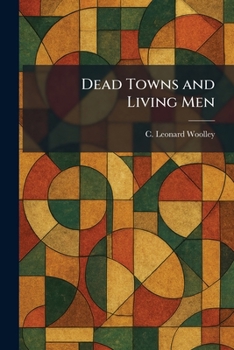
Dead Towns and Living Men

Select Format
Select Condition 
Book Overview
"Dead Towns and Living Men" is a captivating and insightful account of the life and field experiences of the renowned archaeologist C. Leonard Woolley. Moving beyond the confines of technical excavation reports, this work offers a vivid glimpse into the human side of archaeology during the early 20th century. It chronicles Woolley's adventures across the Middle East, Italy, and Egypt, with a particular focus on his significant work at the ancient Hittite city of Carchemish.
The narrative is rich with anecdotes about the diverse people Woolley encountered-ranging from local workmen and tribal leaders to fellow researchers and colorful colonial figures-effectively bridging the gap between the "dead towns" of antiquity and the "living men" of the present. Woolley's writing captures the spirit of exploration, the humor found in cultural misunderstandings, and the physical challenges of digging in remote regions. By blending historical inquiry with personal memoir, the work serves as both an important record of archaeological practice and a compelling travelogue. "Dead Towns and Living Men" remains a classic of its genre, celebrating the adventure and curiosity that drive the search for our shared past.
This work has been selected by scholars as being culturally important, and is part of the knowledge base of civilization as we know it. This work was reproduced from the original artifact, and remains as true to the original work as possible. Therefore, you may see the original copyright references, library stamps (as most of these works have been housed in our most important libraries around the world), and other notations in the work.
This work is in the public domain in the United States of America, and possibly other nations. Within the United States, you may freely copy and distribute this work, as no entity (individual or corporate) has a copyright on the body of the work.
As a reproduction of a historical artifact, this work may contain missing or blurred pages, poor pictures, errant marks, etc. Scholars believe, and we concur, that this work is important enough to be preserved, reproduced, and made generally available to the public. We appreciate your support of the preservation process, and thank you for being an important part of keeping this knowledge alive and relevant.
Customer Reviews
ThriftBooks ® and the ThriftBooks ® logo are registered trademarks of Thrift Books Global, LLC
