


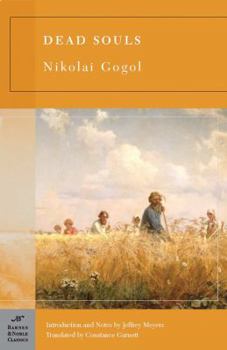
Dead Souls


Select Format
Select Condition 
Book Overview
&&LDIV&&R&&LDIV&&R&&LI&&RDead Souls&&L/I&&R, by &&LB&&RNikolai Gogol&&L/B&&R, is part of the &&LI&&RBarnes & Noble Classics&&L/I&&R&&LI&&R &&L/I&&R&&LI&&R &&L/I&&Rseries, which offers quality editions at affordable prices to the student and the general reader, including new scholarship, thoughtful design, and pages of carefully crafted extras. Here are some of the remarkable features of &&LI&&RBarnes & Noble Classics&&L/I&&R: &&LDIV&&RNew introductions commissioned from todays top writers and scholars Biographies of the authors Chronologies of contemporary historical, biographical, and cultural events Footnotes and endnotes Selective discussions of imitations, parodies, poems, books, plays, paintings, operas, statuary, and films inspired by the work Comments by other famous authors Study questions to challenge the readers viewpoints and expectations Bibliographies for further reading Indices & Glossaries, when appropriateAll editions are beautifully designed and are printed to superior specifications; some include illustrations of historical interest. &&LI&&RBarnes & Noble Classics &&L/I&&Rpulls together a constellation of influences--biographical, historical, and literary--to enrich each readers understanding of these enduring works.&&L/DIV&&R&&L/DIV&&R&&LP style="MARGIN: 0in 0in 0pt"&&R &&L/P&&R&&LP style="MARGIN: 0in 0in 0pt"&&RRussia's first major novel, and perhaps still its most popular, &&LB&&RNikolai Gogol&&L/B&&R's &&LI&&RDead Souls&&L/I&&R is a comic epic of greed and gluttony that is admired not only for its colorful cast of characters and devastating satire, but also for its sense of moral fervor.&&LBR&&R&&LBR&&RThe anti-hero of the novel is a man named Chichikov, who hatches a brilliant plan to get rich quick. He will journey through Russia and buy up, at reduced rates, the recently deceased serfs of landowners, who now won't have to pay government taxes on the 'dead souls.' With this list of fictitious serfs as collateral, Chichikov can buy an estate and begin amassing his fortune. What follows is a series of grotesquely humorous transactions with Russian landowners, each more queer and repellant than the last. Although Gogol spends much of the novel exposing the evils of the Russian gentry through absurd and hilarious satire, he also expresses a passionate love for his country that resonates with readers even today.&&LBR&&R&&LBR&&RA stylistic tour de force, encompassing an astonishing range of voices from delicate, intimate lyricism to robust, bawdy ribaldry, &&LI&&RDead Souls&&L/I&&R is an intensely felt anatomy of the human condition.&&LBR&&R&&L/P&&R&&LP style="MARGIN: 0in 0in 0pt"&&R&&LSTRONG&&RJeffrey Meyers&&L/B&&R,&&L/B&&R a Fellow of the Royal Society of Literature, has published forty-three books, including biographies of Ernest Hemingway, Robert Frost, D. H. Lawrence, Joseph Conrad, and George Orwell. He also wrote the Introductions and Notes to the Barnes & Noble Classics editions of Edith Wharton's &&LI&&RThe House of Mirth&&L/I&&R and Rudyard Kipling's &&LI&&RKim.&&L/I&&R&&L/P&&R&&L/DIV&&R
Format:Paperback
Language:English
ISBN:1593080921
ISBN13:9781593080921
Release Date:May 2005
Publisher:Barnes & Noble Classics
Length:432 Pages
Weight:0.88 lbs.
Dimensions:1.2" x 5.2" x 8.0"
Related Subjects
Class Struggle Wealth Inequality Classic Literature Classics Fiction Literature & FictionCustomer Reviews
2 ratings
sublime, witty and entertaining
Published by Thriftbooks.com User , 22 years ago
Gogol is the master of imagery; in _Dead Souls_ he also shows his skills at hyperbole and satire, showing the vanity and ridiculousness of the Russian gentry in the middle of the 19th century. The plot of the story revolves around a newcomer to an unnamed Russian village (immeadiately under susupicion being an "outsider"), who manages to charm his way into the local scene as a "harmless fellow." Yet soon his plans are revealed: he wishes to purchase the "souls" of dead serfs, the better to establish himself as a member of the landed gentry. Gogol's masterpiece is almost Dickensian in its character development (and in the personalities of some of the characters), but on a deeper level comments on the superfulousness of appearance. It is a wonderful, witty and thoroughly enjoyable read. Highly recommended.
Hilarious social humor, with dark undercurrents
Published by Thriftbooks.com User , 24 years ago
While I was reading this, I couldn't help but compare it to Laurence Sterne's "Life and Opinions of Tristram Shandy." I later found out that Gogol was a fan of that book, so perhaps the parallels are intentional.The protagonist, Chichikov, is a shaggy dog of sorts an average guy from a below-average background, who manages to use his schmoozing skills to get ahead in life, but is ultimately a bit of an insecure charlatan. (Lots of parallels to Jay Gatsby as well.) But, as in Sterne's book, we don't find out much about Chichikov until the very end of the novel -- otherwise, we only see small glimpses of Chichikov in action, and hear the mostly untrue things said about him by those he encounters. (Are these falsehoods of his own making, or of his observers' making? Or of ours, the readers' own making? Not an easy question.) The novel takes us through various parts of Russian society, with many bits of the author's mockery obviously being things Gogol had wanted to get off his chest for quite a while. There are some excellent observations about "the Russian character," human nature, personality types, what different languages are good for, and many, many other bits of Gogolian brilliance. By the way, the financial scheme Chichikov is running is very clever, even by today's standards of financial wizardry.The narrator does a lot of Sterne-like "stepping out of character"; in one of the more hilarious passages, he complains that his pen has suddenly become too heavy to write anything more about a certain character, and that he will take a rest. There are many comments to the effect of "So what kind of a novel were you expecting this to be, dear reader?" perhaps playing upon the shock with which the book was initially received. Also lots of teasing the reader, with back-and-forth to the effect of "should I reveal any more to you, or shouldn't I?"Ultimately, the big question in the book becomes exactly who the "dead souls" are -- and the astute reader will realize that paradoxically, the dead serfs that are being bought and sold are the least dead of all the souls in the book.This book is hilariously funny, and is rewarding even if read for humor alone. However, the literary and narrative experiments it undertakes, as well as its subtle social criticisms, make it even more worthwhile.
Copyright © 2025 Thriftbooks.com
Terms of Use | Privacy Policy | Do Not Sell/Share My Personal Information | Cookie Policy | Cookie Preferences | Accessibility Statement
ThriftBooks ® and the ThriftBooks ® logo are registered trademarks of Thrift Books Global, LLC
ThriftBooks ® and the ThriftBooks ® logo are registered trademarks of Thrift Books Global, LLC
