


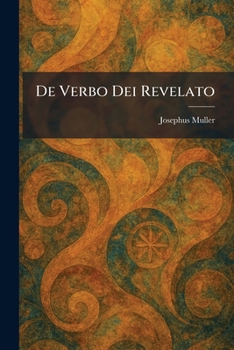
De Verbo Dei Revelato

"De Verbo Dei Revelato" is a scholarly exploration into the theological foundations of divine revelation. Authored by Josephus Muller, this work meticulously examines the ways in which the Word of God has been disclosed to the world and the mechanisms by which it is preserved and interpreted. The treatise is rooted in the tradition of dogmatic theology, offering a rigorous analysis of the intersection between divine truth and human understanding.
Throughout the text, Muller navigates the essential components of Christian revelation, including the role of the Holy Spirit, the integrity of the biblical canon, and the living tradition of the Church. By addressing the philosophical and theological challenges of the era, the work seeks to provide a clear and authoritative defense of the supernatural character of the Christian faith. It is an invaluable resource for students of systematic theology, philosophy of religion, and the history of doctrine.
Focusing on the clarity and certainty of the revealed message, "De Verbo Dei Revelato" remains a significant contribution to early 20th-century religious scholarship. It offers readers a deep dive into the classical understanding of how God speaks to humanity, making it a vital study for anyone interested in the structural pillars of Christian belief and the theological rigor of the Catholic intellectual tradition.
This work has been selected by scholars as being culturally important, and is part of the knowledge base of civilization as we know it. This work was reproduced from the original artifact, and remains as true to the original work as possible. Therefore, you may see the original copyright references, library stamps (as most of these works have been housed in our most important libraries around the world), and other notations in the work.
This work is in the public domain in the United States of America, and possibly other nations. Within the United States, you may freely copy and distribute this work, as no entity (individual or corporate) has a copyright on the body of the work.
As a reproduction of a historical artifact, this work may contain missing or blurred pages, poor pictures, errant marks, etc. Scholars believe, and we concur, that this work is important enough to be preserved, reproduced, and made generally available to the public. We appreciate your support of the preservation process, and thank you for being an important part of keeping this knowledge alive and relevant.
Customer Reviews
ThriftBooks ® and the ThriftBooks ® logo are registered trademarks of Thrift Books Global, LLC
