


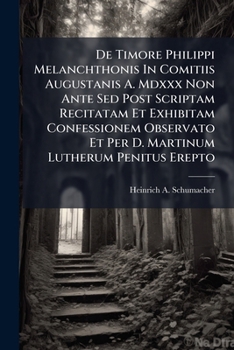
De Timore Philippi Melanchthonis In Comitiis Augustanis A. Mdxxx Non Ante Sed Post Scriptam Recitatam Et Exhibitam Confessionem Observato Et Per D. Ma

Explore the profound impact of Philipp Melanchthon's anxieties during the pivotal Diet of Augsburg in 1530, as detailed in Heinrich A. Schumacher's "De Timore Philippi Melanchthonis In Comitiis Augustanis A. Mdxxx Non Ante Sed Post Scriptam Recitatam Et Exhibitam Confessionem Observato Et Per D. Martinum Lutherum Penitus Erepto." This work delves into the circumstances surrounding Melanchthon's presentation of the Augsburg Confession, examining his state of mind not before but after its recitation and submission.
Schumacher sheds light on the crucial role of Martin Luther in alleviating Melanchthon's fears, offering a nuanced perspective on the interpersonal dynamics that shaped the Reformation. This book offers valuable insights into the complexities of religious reform and the human elements that influenced its course, making it essential reading for historians and theologians interested in the Reformation era.
This work has been selected by scholars as being culturally important, and is part of the knowledge base of civilization as we know it. This work was reproduced from the original artifact, and remains as true to the original work as possible. Therefore, you will see the original copyright references, library stamps (as most of these works have been housed in our most important libraries around the world), and other notations in the work.
This work is in the public domain in the United States of America, and possibly other nations. Within the United States, you may freely copy and distribute this work, as no entity (individual or corporate) has a copyright on the body of the work.
As a reproduction of a historical artifact, this work may contain missing or blurred pages, poor pictures, errant marks, etc. Scholars believe, and we concur, that this work is important enough to be preserved, reproduced, and made generally available to the public. We appreciate your support of the preservation process, and thank you for being an important part of keeping this knowledge alive and relevant.
Customer Reviews
ThriftBooks® and the ThriftBooks® logo are registered trademarks of Thrift Books Global, LLC
