


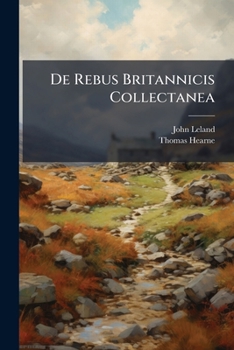
De Rebus Britannicis Collectanea: Appendix

De Rebus Britannicis Collectanea is a seminal work for the study of early modern Britain. Authored primarily by John Leland (1506-1552), with substantial contributions by Thomas Hearne, this collection offers invaluable insights into the historical landscape of the British Isles during the Renaissance. Leland, an antiquary commissioned by Henry VIII, traveled extensively throughout England and Wales, documenting historical sites, manuscripts, and oral traditions. This appendix supplements the core work, providing additional source material and commentary that enriches our understanding of Leland's research and the broader context of British history.
Students and researchers interested in the Tudor period, the history of antiquarianism, and the development of historical scholarship will find "De Rebus Britannicis Collectanea" to be an indispensable resource. It stands as a testament to the enduring importance of primary source material in shaping our understanding of the past.
This work has been selected by scholars as being culturally important, and is part of the knowledge base of civilization as we know it. This work was reproduced from the original artifact, and remains as true to the original work as possible. Therefore, you will see the original copyright references, library stamps (as most of these works have been housed in our most important libraries around the world), and other notations in the work.
This work is in the public domain in the United States of America, and possibly other nations. Within the United States, you may freely copy and distribute this work, as no entity (individual or corporate) has a copyright on the body of the work.
As a reproduction of a historical artifact, this work may contain missing or blurred pages, poor pictures, errant marks, etc. Scholars believe, and we concur, that this work is important enough to be preserved, reproduced, and made generally available to the public. We appreciate your support of the preservation process, and thank you for being an important part of keeping this knowledge alive and relevant.
Customer Reviews
ThriftBooks ® and the ThriftBooks ® logo are registered trademarks of Thrift Books Global, LLC
