


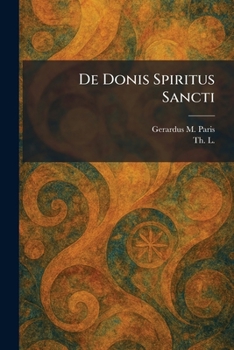
De Donis Spiritus Sancti

"De Donis Spiritus Sancti" is an insightful theological study dedicated to the seven gifts of the Holy Spirit and their vital role in the Christian life. Authored by Fr. Gerardus M. Paris, a member of the Order of Preachers, this work delves into the classic scholastic tradition to explain the supernatural habits that dispose the soul to follow the promptings of the Holy Spirit.
The text focuses on the systematic analysis of how these gifts interact with the theological and moral virtues, a core subject in Thomistic theology. Through careful exposition, the author clarifies the distinctions between the gifts and other forms of grace, providing a roadmap for spiritual growth and deeper contemplation. It is an invaluable resource for scholars, theologians, and anyone interested in the development of pneumatology and the intellectual history of the Dominican tradition.
By presenting a structured and scholarly approach to the inner life of the believer, "De Donis Spiritus Sancti" serves as a foundational text for understanding the theological nuances of divine guidance and the path toward holiness.
This work has been selected by scholars as being culturally important, and is part of the knowledge base of civilization as we know it. This work was reproduced from the original artifact, and remains as true to the original work as possible. Therefore, you may see the original copyright references, library stamps (as most of these works have been housed in our most important libraries around the world), and other notations in the work.
This work is in the public domain in the United States of America, and possibly other nations. Within the United States, you may freely copy and distribute this work, as no entity (individual or corporate) has a copyright on the body of the work.
As a reproduction of a historical artifact, this work may contain missing or blurred pages, poor pictures, errant marks, etc. Scholars believe, and we concur, that this work is important enough to be preserved, reproduced, and made generally available to the public. We appreciate your support of the preservation process, and thank you for being an important part of keeping this knowledge alive and relevant.
Customer Reviews
ThriftBooks ® and the ThriftBooks ® logo are registered trademarks of Thrift Books Global, LLC
