


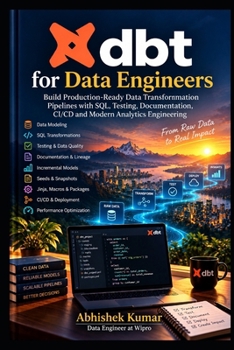
dbt for Data Engineers: Build Production-Ready Data Transformation Pipelines with SQL, Testing, Documentation, CI/CD and Modern Analytics Engineering (Data Engineering Domain For professional)

Modern data teams need more than SQL queries.
As data platforms grow, engineers must build transformation pipelines that are modular, testable, documented, version-controlled, scalable, and production-ready.
dbt for Data Engineers provides a practical guide to using dbt for modern data transformation and analytics engineering.
Starting from the fundamentals, this book takes you through the complete journey of building and managing dbt projects-from your first model to production-oriented CI/CD and performance optimization.
You will learn how to transform raw warehouse data into reliable data products using practical engineering patterns.
Inside the book, you will learn: How dbt fits into a modern data engineering architectureHow dbt projects, models, DAGs, sources, and dependencies workHow to build staging, intermediate, and data mart modelsHow to use ref() and source() effectivelyHow to choose between views, tables, incremental models, and ephemeral modelsHow to write data quality testsHow to use documentation and data lineageHow to build efficient incremental pipelinesHow to use seeds and snapshotsHow to write reusable Jinja macrosHow dbt packages can improve project reusabilityHow to organize large dbt projectsHow Git and CI/CD fit into dbt developmentHow to deploy and monitor production transformationsHow to optimize SQL, models, warehouse usage, and pipeline performanceHow to design maintainable and scalable production data workflowsRather than focusing only on commands, this book emphasizes the engineering principles behind dbt.
You will learn to think about questions such as:
Where did this data come from?
What does one row represent?
How do we know the data is correct?
What happens when source data changes?
Which models depend on this transformation?
How can the pipeline scale as data volume increases?
How can changes be safely tested and deployed?
Whether you are a data engineer, analytics engineer, SQL developer, BI professional, data analyst, or someone transitioning into modern data engineering, this book provides a practical foundation for working with dbt.
The ultimate goal is simple:
Turn SQL transformations into reliable, tested, documented, maintainable, and production-ready data products.
Customer Reviews
ThriftBooks ® and the ThriftBooks ® logo are registered trademarks of Thrift Books Global, LLC
