


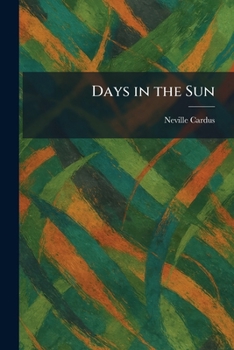
Days in the Sun

Select Format
Select Condition 
Book Overview
"Days in the Sun" is a celebrated collection of cricket writing by the legendary Neville Cardus, widely regarded as one of the most influential sports journalists of the twentieth century. In this evocative work, Cardus transcends simple match reporting to capture the artistry, drama, and unique atmosphere of the sport during a transformative era. The book features a series of lyrical essays and reflections on legendary players, iconic matches, and the enduring spirit of the game as played on the sun-drenched fields of England.
With a characteristic blend of poetic prose and keen technical observation, Cardus brings to life the personalities of the era's greatest cricketers, treating the sport not merely as a record of scores and statistics, but as a profound celebration of cultural significance and aesthetic beauty. This collection serves as a testament to how Cardus elevated sportswriting to the level of literature, weaving together the technicalities of the pitch with a deep appreciation for the human element. "Days in the Sun" remains an essential volume for any enthusiast of cricket history, offering a nostalgic and beautifully written window into the heart of the English summer.
This work has been selected by scholars as being culturally important, and is part of the knowledge base of civilization as we know it. This work was reproduced from the original artifact, and remains as true to the original work as possible. Therefore, you may see the original copyright references, library stamps (as most of these works have been housed in our most important libraries around the world), and other notations in the work.
This work is in the public domain in the United States of America, and possibly other nations. Within the United States, you may freely copy and distribute this work, as no entity (individual or corporate) has a copyright on the body of the work.
As a reproduction of a historical artifact, this work may contain missing or blurred pages, poor pictures, errant marks, etc. Scholars believe, and we concur, that this work is important enough to be preserved, reproduced, and made generally available to the public. We appreciate your support of the preservation process, and thank you for being an important part of keeping this knowledge alive and relevant.
Customer Reviews
ThriftBooks ® and the ThriftBooks ® logo are registered trademarks of Thrift Books Global, LLC
