


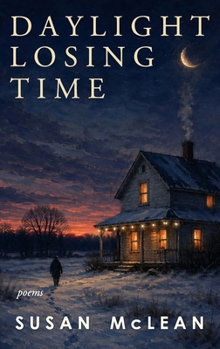
Daylight Losing Time: Poems

Daylight Losing Time, Susan McLean's third full-length collection, turns the poet's formal tools-sonnet, villanelle, triolet, ballade-on the art and aftermath of loss. The book moves through three movements: departures and endings in "The Art of Leaving," where Emily Dickinson writes to Andrew Marvell, Edna St. Vincent Millay gets a sonnenizio, Ursula K. Le Guin receives a moon-haunted elegy, and a mother reads mysteries by Kindle-light through her last illness; the public and planetary disorientations of "Bewildered," with its confused lilacs, locked-down Rome, and police-shooting villanelle; and the fires of memory and self in "Burning the Journals," where Twain, narcissism, and inherited landscapes come under the same unsparing eye. McLean's voice-elegiac, witty, unsparing-finds in traditional forms a shelter tough enough to hold grief and still turn back to the light.
PRAISE FOR DAYLIGHT LOSING TIME:
Sharply observant as Dickinson, worldly-wise as Millay, and darkly funny as Dorothy Parker, Susan McLean is a wholly original talent in American poetry. Hers is the voice of that hilarious best friend who always blurts out blunt truth while everyone else is dissembling. If she were living someplace where the general public still reads poetry, she would likely be a household word, filthy rich from poetry royalties, and the people's choice for poet laureate. But instead, she is our unsung national treasure, and this is her best book yet.
-Julie Kane
[Susan McLean's] poems brim with emotion, but it's usually buried beneath a sharply glittering surface, so that the faultless precision of her meter covers a chaos of old and still raucously raw feeling. Her poems are wittily grim and can be simultaneously acerbic and hilarious (it's no wonder that she has produced an acclaimed book of translations of Martial's epigrams). To find incisive mordancy, technical brilliance, and emotional intensity together in one poem is rare enough; to find them in virtually every poem in a book seems almost impossible, but Daylight Losing Time is such a book. Highly recommended.
-Dick Davis
[These] poems showcase their formal skills just enough to establish the "background music" that language well used creates-the How that makes poetry Poetry-and then allows the reader to focus on the What that all writing needs to be worth reading. In this case, the What includes such considerations as aging, and the changes it works on what we think we know, have, and are; the meaning of words we count on, such as "self," "family," "home," and "dying"; and the preparations we undergo-often unconsciously, earlier than we think-to learn "the art of leaving." Read this book. It will both teach and delight you.
-Rhina P. Espaillat
ABOUT THE AUTHOR:
Susan McLean grew up in Oxon Hill, Maryland, received a BA from Harvard University and a PhD from Rutgers University-New Brunswick. She has published two poetry books: The Whetstone Misses the Knife (Story Line, 2014), which won the Donald Justice Poetry Prize, and The Best Disguise (University of Evansville Press, 2009), which won the Richard Wilbur Award. She has also published one poetry chapbook, Holding Patterns (Finishing Line, 2006), and a book of translations of over 500 poems by the Latin poet Martial, Selected Epigrams (University of Wisconsin Press, 2014), which was a finalist for the PEN Center USA Translation Award. Her poems and translations of poems from French, German, and Latin have appeared in Hunger Mountain, Arion, Subtropics, and elsewhere. She lives in Iowa City, Iowa, with John Finamore.
Related Subjects
PoetryCustomer Reviews
ThriftBooks ® and the ThriftBooks ® logo are registered trademarks of Thrift Books Global, LLC
