


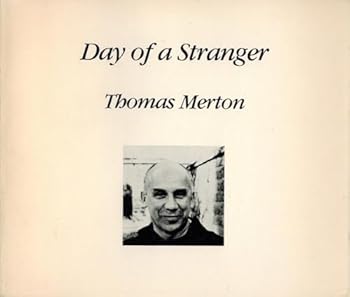
Day of a Stranger

Select Format
Select Condition 
Book Overview
No Synopsis Available.
Format:Paperback
Language:English
ISBN:0879050926
ISBN13:9780879050924
Release Date:January 1981
Publisher:Gibbs M. Smith
Length:63 Pages
Weight:0.26 lbs.
Dimensions:7.0" x 0.2" x 6.0"
Customer Reviews
1 rating
A welcome friend...
Published by Thriftbooks.com User , 20 years ago
In this very brief book, one gets a rare glimpse of Thomas Merton during his hermit days. One sees a bit of stream of consciousness, as well as a bit of organised reflection. The structure of the essay, a mere 34 pages, leads through the course of a single day, but it is obvious that this essay was much longer in the making - not that it took longer to write, but that this kind of writing can only come from an experience of days such as this over a long period of time. There are pieces of description of the woods, the hermitage, and the silence that surrounds Merton, but there is also description of the world around Merton that extends outside the monastic community and the hermit isolation. This world is one that we recognise as readers on the outside, but can also appreciate the sometime strange interpretations that Merton puts on things. Merton's contemplation of the workaday world, of the jet planes flying overhead, and the other aspects of modern life contrast profoundly with the contemplation of the silence broken physically only by the sounds of the wind and the birds. However, the world is very present with Merton in other ways, as one discovers from his discussion on his 'mental ecology'. This includes a landscape that includes Rilke and Lao Tzu, Tertullian and Sartre, John of Salisbury and Flannery O'Connor. 'The spiritual life is something that people worry aout when they are so busy with something else they think they ought to be spiritual. Spiritual life is guilt.' These are strong words from Merton, but it contains an interesting truth - if we make spiritual life one more thing that has to be done, we miss an important point. If we do it because we 'ought' to do it, we start from the wrong standpoint, and thus likely cannot follow the right path. Merton pokes gentle fun at his own practices and ideas of what religious life should be. He writes a brief sermon to birds, a very good one - but the response from the birds is that even this very good, very short two-sentence sermon was one sermon too many. Merton included many black-and-white photos of the woods, the hermitage (which he insisted should be called a house rather than a hermitage), and the monastery. These include bookshelves, chairs and tables, slowly disintegrating wagon wheels, sunlight through the woods - his surroundings, but no pictures of people. This helps to convey the sense of silence. Merton recognises that his day is very different from that of most who will read this text, wherever in the world they may be. His day is strange, and he is a stranger, to most of our lifestyles. Yet he is a welcome friend, an interesting character with which to compare and contrast our own thoughts and feelings. This is an excellent essay with which to begin the study of Merton, as well as a wonderful treat for those who already know his work.
Copyright © 2026 Thriftbooks.com Terms of Use
| Privacy Policy | Do Not
Sell/Share My Personal Information | Cookie Policy | Cookie Preferences | Accessibility Statement
ThriftBooks® and the ThriftBooks® logo are registered trademarks of Thrift Books Global, LLC
ThriftBooks® and the ThriftBooks® logo are registered trademarks of Thrift Books Global, LLC
