


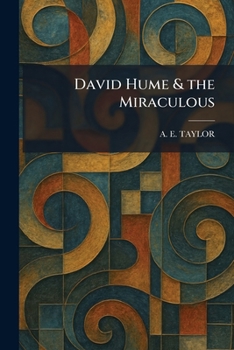
David Hume & the Miraculous

In "David Hume & the Miraculous," A. E. Taylor provides a rigorous philosophical examination of one of the most debated topics in Enlightenment thought: David Hume's critique of miracles. This work engages deeply with the arguments presented in Hume's "Enquiry Concerning Human Understanding," specifically the celebrated section "Of Miracles." Taylor, a distinguished philosopher in his own right, scrutinizes Hume's epistemological foundations and the logical structure of his skepticism regarding supernatural events.
The book explores the tension between empirical evidence and the laws of nature, questioning whether Hume's rejection of miraculous testimony is a necessary consequence of his philosophical system or a result of specific historical prejudices. Taylor's analysis delves into the definition of a miracle, the nature of probability, and the criteria for credible human testimony.
This volume is an essential resource for scholars and students of the philosophy of religion, historical theology, and British empiricism. By revisiting Hume's challenges through a 20th-century lens, "David Hume & the Miraculous" remains a significant contribution to the ongoing dialogue between faith and reason, offering a sophisticated defense of the intellectual possibility of the miraculous against rigid naturalism.
This work has been selected by scholars as being culturally important, and is part of the knowledge base of civilization as we know it. This work was reproduced from the original artifact, and remains as true to the original work as possible. Therefore, you may see the original copyright references, library stamps (as most of these works have been housed in our most important libraries around the world), and other notations in the work.
This work is in the public domain in the United States of America, and possibly other nations. Within the United States, you may freely copy and distribute this work, as no entity (individual or corporate) has a copyright on the body of the work.
As a reproduction of a historical artifact, this work may contain missing or blurred pages, poor pictures, errant marks, etc. Scholars believe, and we concur, that this work is important enough to be preserved, reproduced, and made generally available to the public. We appreciate your support of the preservation process, and thank you for being an important part of keeping this knowledge alive and relevant.
Customer Reviews
ThriftBooks ® and the ThriftBooks ® logo are registered trademarks of Thrift Books Global, LLC
