


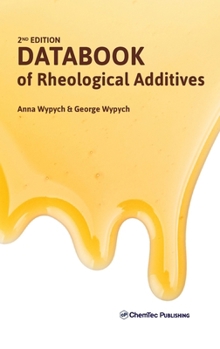
Databook of Rheological Additives
No Customer Reviews

Rheological additives are commonly applied in a wide range of industries and the Databook of Rheological Additives provides readers with information on over 300 organic and inorganic additives. This information is presented in individual tables for each product, whether commercial or generic. The data are divided into five groups, those being General Information, Physical Properties, Health and Safety, Ecological Properties, and Use and Performance. The following information is included in each section: General Information: name, CAS #, EC #, IUPAC name, common name, common synonyms, acronym, biobased, cellulose functionality, charge, degree of substitution, empirical formula, chemical structure, molecular mass, RTECS number, chemical category, product class, product composition, moisture content, and solids content. Physical Properties: state, odor, color, bulk density, density, specific gravity, relative density, boiling point, melting point, pour point, decomposition temperature, glass transition temperature, refractive index, vapor pressure, vapor density, volume resistivity, relative permittivity, ash content, pH, viscosity, rheological behavior, absolute viscosity, surface tension, hydration time, solubility in solvents, solubility in water, the heat of combustion, the heat of decomposition, specific heat, thermal conductivity, Henry's law constant, particle size, and volatility. Health & Safety: NFPA classification, HMIS classification, OSHA hazard class, UN Risk phrases, UN Safety phrases, UN/NA class, DOT class, ADR/RIC class, ICAO/IATA class, IMDG class, packaging group, shipping name, food approvals, autoignition temperature, self-accelerating decomposition temperature, flash point, TLV ACGIH, NIOSH and OSHA, maximum exposure concentration IDLH, animal testing oral-rat, rabbit-dermal, mouse-oral, guinea pig-dermal, rat-dermal, rat-inhalation, mouse-inhalation, ingestion, skin irritation, eye irritation, inhalation, first aid eye, skin, and inhalation, carcinogenicity IARC, NTP, OSHA, ACGIH, and mutagenicity. Ecological Properties: biological oxygen demand, chemical oxygen demand, theoretical oxygen demand, biodegradation probability, aquatic toxicity algae, Rainbow trout, Sheepshead minnow, Fathead minnow, and Daphnia magna, and partition coefficient. Use & Performance: manufacturer, product feature, recommended for polymers, recommended for products, outstanding properties, compatibility, limitations, a typical reason for use, processing methods, the concentration used, storage temperature, and food approval.
Format:Hardcover
Language:English
ISBN:1774671085
ISBN13:9781774671085
Release Date:March 2027
Publisher:Chemtec Publishing
Length:672 Pages
Weight:2.28 lbs.
Dimensions:1.3" x 6.1" x 9.2"
Customer Reviews
0 rating
Copyright © 2026 Thriftbooks.com
Terms of Use | Privacy Policy | Do Not Sell/Share My Personal Information | Cookie Notice | Cookie Preferences | Accessibility Statement
ThriftBooks ® and the ThriftBooks ® logo are registered trademarks of Thrift Books Global, LLC
ThriftBooks ® and the ThriftBooks ® logo are registered trademarks of Thrift Books Global, LLC
