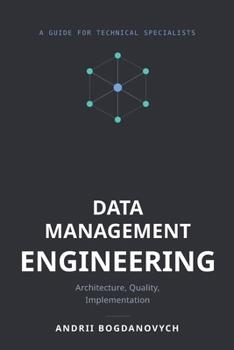
Data Management Engineering: Architecture, Quality, Implementation

You know your database, your ETL tool, your BI platform cold. What you were never taught is how they fit together.
You've built pipelines that work but nobody can trace a bad number back through. You've modeled data that's technically correct but has no shared glossary behind it, and shipped a quality check nobody ties back to an actual business consequence. Every decision was locally sound - the system as a whole is still incoherent.
Data Management Engineering gives you the map individual tools never come with: a coherent framework connecting architecture, modeling, storage, integration, quality, and governance into one system, instead of disconnected specialties each learned from a different vendor's docs.
The book translates the systematized practices of the international data management profession into concrete engineering decisions - architecture-selection criteria, model-design checklists, rollout sequences for quality controls - not vendor marketing or abstract principles with no decision attached. One running example, a single online store, runs through all twenty-one chapters, showing how decisions in one chapter constrain the ones after it, instead of a string of unrelated toy examples.
What's inside
Twenty-one chapters in seven parts:
Part I - Foundations. The core framework, data-handling ethics, and data governance strategy, tooling, standards, and metrics.
Part II - Architecture and Modeling. Data architecture, the entity-relationship approach, and alternative notations - multidimensional, object-oriented, fact-based, temporal, NoSQL - with criteria for choosing among them.
Part III - Storage, Security, and Integration. Database operations, data security, and integration patterns: ETL versus ELT, enterprise service bus, APIs.
Part IV - Content, Reference, and Master Data. Document and content management, electronic discovery, reference and master data, entity resolution.
Part V - Analytics, Metadata, and Quality. Data warehousing and business intelligence, metadata management, measuring and implementing data quality.
Part VI - Big Data and Data Science. Strategy, sources, tools, techniques, and governance for large volumes of loosely structured data.
Part VII - Maturity, Organization, and Change. Assessing your organization's data maturity, structuring roles, and managing the change that decides whether any of it sticks.
Who this book is for
Data engineers and architects designing systems that need to outlive the person who built themDBAs and integration developers who want the reasoning behind the pattern, not just the patternAnalysts and BI developers who need to trace a number back to where it actually came fromData stewards and quality leads implementing controls tied to a real business consequenceA basic familiarity with databases and the software development lifecycle is assumed.
Why this book is different
Built for decisions, not definitions. Every chapter hands you selection criteria - relational versus NoSQL, Inmon versus Kimball - not a glossary to memorize.One consistent vocabulary, cover to cover. Twenty-one chapters share one set of concepts, tied together by a consolidated glossary - terminology never drifts the way it does across scattered vendor docs.One example, twenty-one chapters. The same online store - the same Customer, Product, and Order entities - carries you from storage design through organizational change, so decisions compound instead of resetting each chapter.If you've ever had to reverse-engineer another engineer's data model, or explain why a "correct" pipeline produced the wrong number, this book gives you the shared framework that was missing.
Customer Reviews
ThriftBooks ® and the ThriftBooks ® logo are registered trademarks of Thrift Books Global, LLC