


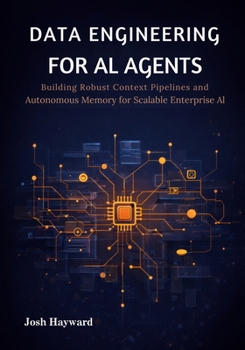
Data Engineering for AI Agents: Building Robust Context Pipelines and Autonomous Memory for Scalable Enterprise AI

Building AI agents that work in a demo is easy. Building AI agents that stay reliable under real enterprise pressure is where most teams hit the wall. Context arrives late, memory becomes noisy, retrieval breaks under scale, and autonomous systems start making decisions on incomplete or stale data. The problem is rarely the model alone. The real challenge is the data engineering behind the agent.
Data Engineering for AI Agents shows how to design the pipelines, memory layers, and retrieval systems that make autonomous AI dependable in production. Instead of treating agents as isolated chat interfaces, this book frames them as data-driven systems that need structured context, durable memory, safe tool access, and scalable orchestration. Drawing on the book's emphasis on context pipelines, memory tiering, retrieval, MCP connectivity, and enterprise deployment, it focuses on what actually keeps agentic systems stable and useful at scale.
Readers will learn how to:
Build robust context pipelines that feed agents timely, high-signal informationDesign short-term and long-term memory architectures for autonomous workflowsImprove retrieval quality with agentic RAG, metadata enrichment, and multi-tier strategiesConnect agents to tools, databases, and enterprise systems safely and reliablyEngineer for observability, governance, cost control, and production-scale deploymentWhether the goal is to support internal copilots, decision systems, or autonomous enterprise workflows, this book provides a practical blueprint for turning AI agents into resilient, context-aware systems that can remember, reason, and act with confidence.
Customer Reviews
ThriftBooks ® and the ThriftBooks ® logo are registered trademarks of Thrift Books Global, LLC
