


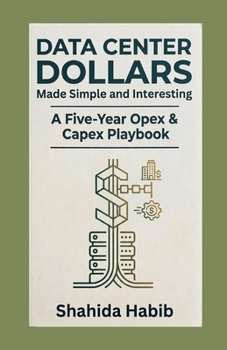
Data Center Dollars - Made Simple and Interesting: A Five-Year Opex & Capex Playbook
No Customer Reviews

Data center budgets have a reputation problem. Say "capex" in a meeting and half the room checks out. Say "five-year forecast" and people start calculating how long until lunch. That reputation is undeserved, because the actual ideas behind a data center budget are not complicated. They only look complicated because of how they're usually explained.
Strip away the spreadsheets and a data center budget is answering two honest questions, repeated for five years running: what are we building, and what does it cost to keep it running once it's built? Depreciation schedules, PUE calculations, escalation curves, board decks - all of it sits on top of that simple foundation. None of it replaces it.
Somewhere along the way, budgeting became treated like a specialist's dark art - something only finance teams and a handful of veteran engineers could speak fluently. That gatekeeping doesn't serve anyone. The engineer who understands the cooling plant better than anyone in the building often has no seat at the budget table, because the language of budgeting was never built for them. The finance lead approving an eight-figure capex request may never have stood inside a data hall or felt what thirty racks at full load actually sound like. Both are missing half the picture, and the budget suffers for it.
This book closes that gap by explaining the real mechanics - the ones used in actual capital planning committees - the way a good mentor would, before you're ever sitting in front of a spreadsheet under deadline. Simplicity here isn't a writing style. It's the argument. If a budgeting concept can't be explained simply, it usually means it hasn't been understood simply yet, by anyone - including whoever is presenting it. Every chapter tries to fix that: a real scenario first, then the concept, then the mechanics underneath it, then a single sentence you could repeat in a hallway and have it land.
By the end of this book, you'll be able to build a five-year data center budget, explain every line in it in plain language, defend the assumptions behind each number, and present the whole thing to a board without switching into jargon halfway through a sentence. Let's start with the two words that cause the most confusion in the field - and that turn out to be far simpler than their reputation suggests.
Strip away the spreadsheets and a data center budget is answering two honest questions, repeated for five years running: what are we building, and what does it cost to keep it running once it's built? Depreciation schedules, PUE calculations, escalation curves, board decks - all of it sits on top of that simple foundation. None of it replaces it.
Somewhere along the way, budgeting became treated like a specialist's dark art - something only finance teams and a handful of veteran engineers could speak fluently. That gatekeeping doesn't serve anyone. The engineer who understands the cooling plant better than anyone in the building often has no seat at the budget table, because the language of budgeting was never built for them. The finance lead approving an eight-figure capex request may never have stood inside a data hall or felt what thirty racks at full load actually sound like. Both are missing half the picture, and the budget suffers for it.
This book closes that gap by explaining the real mechanics - the ones used in actual capital planning committees - the way a good mentor would, before you're ever sitting in front of a spreadsheet under deadline. Simplicity here isn't a writing style. It's the argument. If a budgeting concept can't be explained simply, it usually means it hasn't been understood simply yet, by anyone - including whoever is presenting it. Every chapter tries to fix that: a real scenario first, then the concept, then the mechanics underneath it, then a single sentence you could repeat in a hallway and have it land.
By the end of this book, you'll be able to build a five-year data center budget, explain every line in it in plain language, defend the assumptions behind each number, and present the whole thing to a board without switching into jargon halfway through a sentence. Let's start with the two words that cause the most confusion in the field - and that turn out to be far simpler than their reputation suggests.
Format:Paperback
Language:English
ISBN:B0H9YZVFBL
ISBN13:9798188511067
Release Date:July 2026
Publisher:Independently Published
Length:206 Pages
Weight:0.54 lbs.
Dimensions:0.4" x 5.5" x 8.5"
Customer Reviews
0 rating
Copyright © 2026 Thriftbooks.com
Terms of Use | Privacy Policy | Do Not Sell/Share My Personal Information | Cookie Notice | Cookie Preferences | Accessibility Statement
ThriftBooks ® and the ThriftBooks ® logo are registered trademarks of Thrift Books Global, LLC
ThriftBooks ® and the ThriftBooks ® logo are registered trademarks of Thrift Books Global, LLC
