


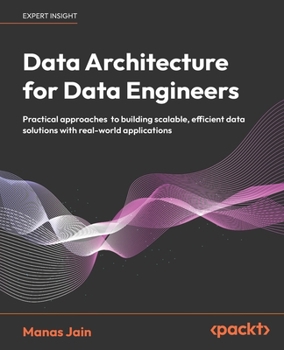
Data Architecture for Data Engineers: Practical approaches to building scalable, efficient data solutions with real-world applications

Develop practical data architecture skills for modern data platforms and learn how to build governed, reliable, and scalable systems while aligning technical choices with organizational goals and operational requirements
Key Features:
- Evaluate architecture options using structured reviews and decision frameworks
- Build governed, reliable data platforms with clear ownership and accountability
- Apply architecture patterns to solve real-world business and operational challenges
Book Description:
Data Architecture for Data Engineers helps data engineers move beyond pipelines and tools to understand how scalable data solutions are designed.
Starting with the foundations, you will learn the principles behind data architecture, including governance, data quality, security, scalability, accessibility, lineage, and stewardship. You'll then work through data modeling and database design, comparing conceptual, logical, and physical models, relational databases, NoSQL databases, columnar databases, normalization, denormalization, and trade-offs behind design choices. The book then moves into data pipelines, covering ingestion, processing, storage, ETL, ELT, batch and real-time processing, monitoring, optimization, and robust design. You will compare data lakes, data warehouses, lakehouses, data mesh, and data fabric, and see where AWS, Azure, Databricks, Delta Lake, Snowflake, and pipeline tools fit into modern architectures. Practical scenarios show how industries shape requirements and why architecture must follow the use case, not trend.
By the end, you will have a view of data solutions and a framework for choosing solutions that fit business needs.
What You Will Learn:
- Assess architecture options using practical decision frameworks
- Align technical designs with business priorities and operational constraints
- Choose suitable models for relational, NoSQL, and columnar data
- Design reliable batch, streaming, ETL, and ELT pipelines
- Compare warehouses, lakes, lakehouses, mesh, and fabric patterns
- Apply governance, quality, security, and ownership principles
- Use decision frameworks to review and improve data platforms
Who this book is for:
Data Architecture for Data Engineers is for data engineers who want to expand beyond implementation and contribute to architecture, technical strategy, and platform design. It is ideal for professionals working with platforms, pipelines, databases, analytics, or cloud services who want to understand how systems are planned, governed, and evolved. Readers should know basic data engineering concepts, SQL, and cloud fundamentals. It also benefits aspiring data architects, analytics engineers, BI developers, analysts, software engineers, and technical managers seeking practical design guidance.
Table of Contents
- Introduction to Data Architecture
- Data Modeling for Effective Architectures
- Architecting Data Pipelines
- Modern Data Architectures
- Cloud Data Architecture: Tools and Technologies
- Choosing a Data Architecture and the Road to Becoming a Data Architect
Customer Reviews
ThriftBooks ® and the ThriftBooks ® logo are registered trademarks of Thrift Books Global, LLC
