


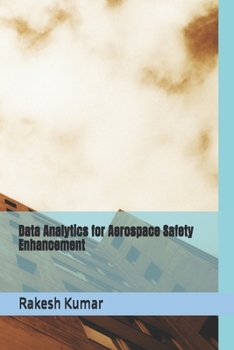
Data Analytics for Aerospace Safety Enhancement
No Customer Reviews

The aerospace industry stands among the most complex, high-risk, and technologically advanced sectors in the world. Every aircraft takeoff, satellite launch, air traffic movement, and maintenance decision depends on the flawless coordination of people, machines, software, and environmental systems. In such a demanding domain, safety is not merely a priority-it is the foundation upon which trust, reliability, and progress are built. Even a minor anomaly in an engine sensor, a communication delay, an unexpected weather shift, or a maintenance oversight can lead to serious operational consequences. As aerospace systems become more connected and data-rich, traditional safety methods alone are no longer sufficient. This is where data analytics emerges as a transformative force.
Modern aerospace operations generate enormous volumes of data every second. Aircraft engines stream telemetry, flight systems record operational parameters, airports collect traffic and ground movement data, satellites transmit environmental and positional information, and maintenance teams document inspections and repairs. Hidden within these vast datasets are patterns, signals, and insights that can help predict failures, prevent accidents, optimize performance, and strengthen decision-making. Data analytics enables organizations to convert raw information into actionable intelligence-shifting safety management from reactive investigation to proactive prevention.
This book, Data Analytics for Aerospace Safety Enhancement, explores how advanced analytics techniques are reshaping the future of aviation and space safety. It provides a practical and strategic understanding of how descriptive analytics, predictive modeling, machine learning, artificial intelligence, anomaly detection, digital twins, IoT systems, and real-time monitoring can be applied across aerospace environments. From aircraft engine health monitoring and pilot fatigue detection to runway safety, air traffic conflict prediction, satellite collision avoidance, and emergency landing decision support, the opportunities are vast and rapidly expanding.
The purpose of this book is to bridge the gap between aerospace operations and modern data science. It is written for engineers, safety professionals, airline managers, researchers, students, technology leaders, and policymakers who seek to understand how data-driven approaches can reduce risk and improve resilience. While technical in vision, the content is designed to remain accessible and practical, combining concepts, case studies, implementation examples, and future trends.
A major theme throughout this book is the evolution from reactive safety to predictive and prescriptive safety. In the past, organizations often relied heavily on incident reports and post-event investigations. Today, analytics allows early detection of weak signals before they become failures. Tomorrow, intelligent systems will not only predict risks but also recommend or autonomously execute optimal safety actions in real time.
The aerospace sector is entering a new era defined by autonomous systems, urban air mobility, smart airports, reusable rockets, satellite constellations, and increasingly complex global operations. These innovations bring extraordinary possibilities-but also new safety challenges. Data analytics provides the tools needed to manage this complexity with speed, precision, and confidence.
As you begin this book, you are stepping into a field where mathematics meets mission readiness, where algorithms protect lives, and where insight can prevent disaster. The future of aerospace safety will not be shaped by data alone, but by how intelligently we use it. This book is an invitation to explore that future.
Modern aerospace operations generate enormous volumes of data every second. Aircraft engines stream telemetry, flight systems record operational parameters, airports collect traffic and ground movement data, satellites transmit environmental and positional information, and maintenance teams document inspections and repairs. Hidden within these vast datasets are patterns, signals, and insights that can help predict failures, prevent accidents, optimize performance, and strengthen decision-making. Data analytics enables organizations to convert raw information into actionable intelligence-shifting safety management from reactive investigation to proactive prevention.
This book, Data Analytics for Aerospace Safety Enhancement, explores how advanced analytics techniques are reshaping the future of aviation and space safety. It provides a practical and strategic understanding of how descriptive analytics, predictive modeling, machine learning, artificial intelligence, anomaly detection, digital twins, IoT systems, and real-time monitoring can be applied across aerospace environments. From aircraft engine health monitoring and pilot fatigue detection to runway safety, air traffic conflict prediction, satellite collision avoidance, and emergency landing decision support, the opportunities are vast and rapidly expanding.
The purpose of this book is to bridge the gap between aerospace operations and modern data science. It is written for engineers, safety professionals, airline managers, researchers, students, technology leaders, and policymakers who seek to understand how data-driven approaches can reduce risk and improve resilience. While technical in vision, the content is designed to remain accessible and practical, combining concepts, case studies, implementation examples, and future trends.
A major theme throughout this book is the evolution from reactive safety to predictive and prescriptive safety. In the past, organizations often relied heavily on incident reports and post-event investigations. Today, analytics allows early detection of weak signals before they become failures. Tomorrow, intelligent systems will not only predict risks but also recommend or autonomously execute optimal safety actions in real time.
The aerospace sector is entering a new era defined by autonomous systems, urban air mobility, smart airports, reusable rockets, satellite constellations, and increasingly complex global operations. These innovations bring extraordinary possibilities-but also new safety challenges. Data analytics provides the tools needed to manage this complexity with speed, precision, and confidence.
As you begin this book, you are stepping into a field where mathematics meets mission readiness, where algorithms protect lives, and where insight can prevent disaster. The future of aerospace safety will not be shaped by data alone, but by how intelligently we use it. This book is an invitation to explore that future.
Format:Paperback
Language:English
ISBN:B0GY4G2C3G
ISBN13:9798258347626
Release Date:April 2026
Publisher:Independently Published
Length:774 Pages
Weight:2.24 lbs.
Dimensions:1.5" x 6.0" x 9.0"
Customer Reviews
0 rating
Copyright © 2026 Thriftbooks.com
Terms of Use | Privacy Policy | Do Not Sell/Share My Personal Information | Cookie Policy | Cookie Preferences | Accessibility Statement
ThriftBooks ® and the ThriftBooks ® logo are registered trademarks of Thrift Books Global, LLC
ThriftBooks ® and the ThriftBooks ® logo are registered trademarks of Thrift Books Global, LLC
