


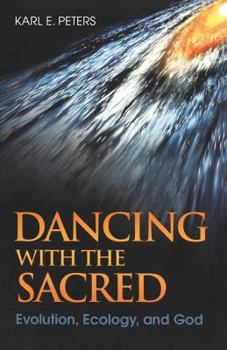
Dancing with the Sacred


Select Format
Select Condition 
Book Overview
"Karl Peters, culminating a lifetime of leadership in the science and religion dialogue, offers a rare combination of both theory and practice, the learned and the existential. Here is an exemplary role model of participating in the creative process -- what Peters metaphorically calls 'dancing with the sacred.'" -- Holmes Rolston, University Distinguished Professor, Colorado State University
Format:Paperback
Language:English
ISBN:1563383934
ISBN13:9781563383939
Release Date:August 2002
Publisher:Bloomsbury Academic & Professional
Length:182 Pages
Weight:0.58 lbs.
Dimensions:0.5" x 5.5" x 8.5"
Customer Reviews
3 ratings
Giving words to a soul's journey
Published by Thriftbooks.com User , 21 years ago
When I picked up this book, I did not know that I would find a kindred spirit within its pages. For over 10 years, I had been adrift in a wash of religious confusion, having come to a realization that the Christian faith of my upbringing simply didn't "work" for me. As a person inspired by science, and working within the field, I found much sacred inspiration in the workings of the natural world. The same is true for my husband. Having grown up in a culture that strictly defines science and religion as very separate entities, it was difficult to express my feelings on the subject. A few pages into Peters' book, I began to weep for joy. Finally, someone had given words to what I had been contemplating for so long. Finally, I had a chance to believe in the "divine" in a way that meshed with my scientific views. This book has changed my life for the better. I am very grateful to Dr. Peters, and hope to thank him personally someday. He's brought me a good deal of peace, and has helped to bring structure to my religious worldview. This book brought me home - that's the best way to describe it.
Dancing with no one leading, metaphor for evolution
Published by Thriftbooks.com User , 23 years ago
The author needs to be deeply thanked for writing a book so heartfelt and expressive of important and sensitive things he has experienced in his life. Simply on the level of a very personal and thoughtful autobiography this is an excellent and to-be-recommended book.But it is more than simply a discussion of one man's spiritual journey, it is a good introduction to process theology and the way creative and deeply centered humanism is taking ideas and weaving them with the idea of evolution and progress to build new theologies. Now i do not share the authors viewpoint nor his basic theology, but the ideas he shares are clearly and forcible stated. Well backed up with current explanations interwoven with the authors own carefully analysed life experiences. The writing is presented as a dialogue, an offering to the reader of wisdom, hard won in struggles of the soul on dark nights. You sympathize, you understand, he shows you what he believes without trying to persuade or convince, this is the book's great strength. The tone, the spiritual journey, the relevance to modern evolutionary thought, all make this a good recommendation for an introduction to evolutionary process theology, as explained in terms of a dance:pg 46 chapter entitled "darwin and the dance of tao". "The best kind of dancing is when no one leads, when the leading is a back and forth sharing, when each party responds to the subtle movements, touches, gestures, and words of the other.... Dancing with no one leading, with no goal or purpose but the dance itself, is a good metaphor for portraying our contemporary scientific understanding fo evolution on our planet. If one follows strictly the philosophical implications of neo-Darwinian theory, there is no overall purpose to evolution."Thanks for reading this review and i hope you enjoy the book as much as i did.richard williams
Natural approaches to Religion can have "Oomph."
Published by Thriftbooks.com User , 24 years ago
As president of IRAS (the Institute on Religion in an Age of Science) I know that one of the most persistent accusations against those who try to understand religion naturally, is that there is no "oomph," no emotional depth, in what they say. It is too rational.It would be hard to imagine that accusation being made against Karl Peters's book "Dancing With the Sacred." Page after page reveals the sense of struggle, and ultimately the sense of joy, that Peters has experienced in terms of making sense of his own life and that of friends he observes. The result is not a syrupy story, however. It is a deeply emotional and satisfying, but still deeply rational and objective, treatment of issues that have traditionally been dealt with supernaturally. Peters shows in sensitive detail why supernatural treatments have not worked for him, why he thinks (accurately, in my opinion) that they have not worked for large segments of modern persons, and most importantly how a more natural approach CAN and DOES work.The subtitle (Evolution, Ecology and God) gives a hint of the approach Peters takes, and the Table of Contents gives other hints (with Chapter titles like "To Err is Divine," "Morality and Meaning for our `Big Selves'," and "Seeking our Sacred Center."), but it in only in reading the actual paragraphs, word by word, that the full impact of his message comes through. Don't worry, it is a slim volume, and Peters is a gifted writer, so it will NOT be hard reading.One final comment. Some of those chapter titles may seem like "New Age" titles. And indeed I suspect what Peters says would dovetail with at least some New Age approaches. The overall message goes much deeper than that, however, because it is a message about sophisticated science and sophisticated religion, showing in ordinary and even friendly language how they can come together. Peters comes at this endeavor from a lifetime of work in the Science/Religion field - he is co-editor of the premier journal in the field "Zygon: Journal of Religion & Science," and he has written frequently in the area. This book, however, is the most complete treatment of his ideas to date, and those ideas are presented exceedingly well. I will predict that many readers will find it the most exciting thing they have ever read.
Copyright © 2026 Thriftbooks.com
Terms of Use | Privacy Policy | Do Not Sell/Share My Personal Information | Cookie Notice | Cookie Preferences | Accessibility Statement
ThriftBooks ® and the ThriftBooks ® logo are registered trademarks of Thrift Books Global, LLC
ThriftBooks ® and the ThriftBooks ® logo are registered trademarks of Thrift Books Global, LLC
