


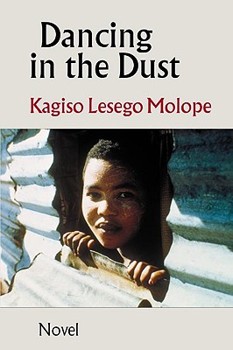
Dancing in the Dust


It is the turbulent 1980s in apartheid South Africa, when even the ordinary life is full of danger and uncertainty. What will tomorrow bring? Tihelo, a thirteen-year-old girl, lives with her older sister Keitumetse and their mother Kgomotso. Kgomotso works as a maid for a white household in the city and has to depend on the neighbours to keep an eye on the girls; one day she does not come home.
Dancing in the Dust is a moving story of growing up in a fearful, oppressive society, where the only comfort for the young is dream and romance, and the only free option that of rebellion.
Format:Paperback
Language:English
ISBN:1894770013
ISBN13:9781894770019
Release Date:January 2002
Publisher:Tsar Publications
Length:192 Pages
Weight:0.70 lbs.
Dimensions:0.6" x 6.0" x 8.8"
Customer Reviews
3 ratings
Exellent
Published by Thriftbooks.com User , 22 years ago
this book gives a chilling discription of south africa not so long ago.
Struggle in South Africa
Published by Thriftbooks.com User , 22 years ago
Molope's book is about a young girl living in apartheid South Africa in the 1980s. Having not read about/experienced the height of the circumstances before, I found this book to be quite moving in its depiction of the brutality incurred by blacks due to the socio-political conditions of the country. The protagonist, Tihelo, is forced to grow up quickly, due to her peers' increasing desire for freedom from oppression, which amplifies a "normal" coming of age story. Molope does not shy away from the violence of the struggle, and uses it to bring attention to the strength of Tihelo, who comes to represent the hardships of an entire race. I recommend this book highly!
A chilling coming of age, by Jim Bartley, Globe and Mail
Published by Thriftbooks.com User , 22 years ago
Post-thunderstorm, the peach trees are denuded of their ripe fruit, the ground under them littered with mush. In this segregated black township in 1980s South Africa, 13-year-old Tihelo sits alone in the overheated air, half of her body in sun, half in shade."It didn't feel like one of those dangerous afternoons we were constantly anticipating, the kind where policemen in their obnoxious and invasive green vans roamed the streets . . . then left with a few victims."But the stillness leaves her missing the familiar cacophony, "weddings, parties, street fights, street games, or riots. Silence was chilling."Light and shade, heat and chill, consoling chaos and ominous calm. Kagiso Lesego Molope fills the first paragraphs of her debut novel with the tension of opposites. Her narrator lives between poles, in constant and exhausting anticipation of "death or celebration." In a land torn by volatile perceptions of light and dark, Tihelo has the burden of being not only Black, the capital B showing official designation, but lighter-skinned than her neighbours. "Even in my house everyone looked more like each other than they looked like me." Growing up, she quickly learned that questions about her pale skin only offended and shamed her mother.One day, as she's playing in the yard, her friend Tshepo asks if she knows how to make a petrol bomb. He proceeds to scrounge a beer bottle and a rag from the street trash, and before her eyes constructs a molotov cocktail, lamenting the lack of gas to fuel it. Not long after, he's taking part in riots with older boys and coming home covered in bruises.As Tihelo enters high school, she loses her best friend, Thato, to a new "multiracial" Catholic school. Thato's new classmates quickly instill contempt for her origins, which rubs off on Tihelo; envy and shame fester inside her, turning slowly to motivating anger as friends begin to raise her political consciousness.Returning one night from her cleaning job in a white district, Tihelo's mother is detained and beaten by police. It's a turning point. Once aghast at the idea, Tihelo finds herself working for the student wing of the African National Congress. Her duties include driving underage in borrowed cars, cruising remote roads to pick up the battered bodies of the missing. And then things get worse.Molope's scenes of police brutality and its human cost are almost cinematic in clarity. Tihelo's unembellished and dispassionate voice completely convinces as that of a young woman whose memory of torment and violation must be recounted with dry precision or not at all. The lack of emotion on the surface of this writing only better exposes its harrowing depths.Molope first makes her reader see and understand, then in the wake of seeing, feel the enormity of apartheid's atrocity, and grieve.
Copyright © 2026 Thriftbooks.com Terms of Use
| Privacy Policy | Do Not
Sell/Share My Personal Information | Cookie Policy | Cookie Preferences | Accessibility Statement
ThriftBooks® and the ThriftBooks® logo are registered trademarks of Thrift Books Global, LLC
ThriftBooks® and the ThriftBooks® logo are registered trademarks of Thrift Books Global, LLC
