


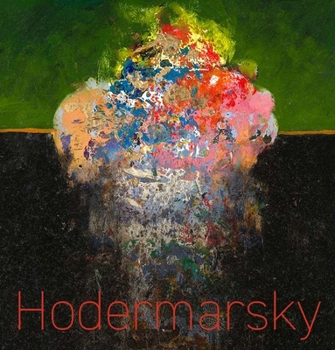
Hodermarsky

Daniel Hodermarsky was the son of Slovak immigrants who emigrated from Hačava to settle and work in the coal fields of Pennsylvania and later in the auto-manufacturing industries of Ohio. He served in World War II on the Western front and was awarded two presidential citations, two Croix de Guerre, and one combat star. He returned home with severe and persistent post-traumatic stress disorder that left an indelible mark on his life and art.
Throughout his career, Hodermarsky's work embraced both the representational and the abstract. His early works experimented with new media (such as Dayglo paint) and new styles such as Op Art and performance. In the 1970s and beyond, he engaged landscape--rural, urban, and imaginary--wherein he explored the interplay of terrain (land or water, horizon, and sky). The human figure--Slovak farmers, wounded or dismembered soldiers, and mythical and historical figures--were among his favorite subjects. He was fascinated by how age, human nature, and personality combine to create the physical form. His eclectic themes mirror his own unique complexities and experiences. Later in his career, he focused on abstract works that reflect the intricate spaces of both his psyche and shared human experience.
A deeply spiritual man with a strong religious faith, Hodermarsky's abstract paintings ask the existential questions that have challenged humankind across millennia. By showing us his own experience of these great mysteries, his art underscores life's abiding beauty. Over his long career of interpreting the world in which he lived, Hodermarsky invites us to inhabit a realm filled with joy, reverence, and passion.
Customer Reviews
ThriftBooks® and the ThriftBooks® logo are registered trademarks of Thrift Books Global, LLC
