


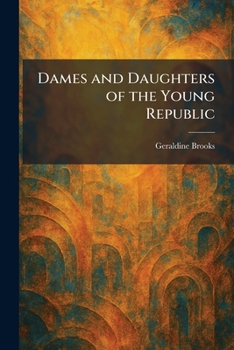
Dames and Daughters of the Young Republic

"Dames and Daughters of the Young Republic" offers a series of captivating biographical sketches that illuminate the lives and contributions of prominent women during the formative years of the United States. Geraldine Brooks provides a window into the social and political landscape of the early nineteenth century through the experiences of influential figures such as Dolly Madison, Elizabeth Patterson Bonaparte, and Martha Jefferson Randolph. By focusing on the women who shaped the domestic and social circles of the young nation, the work explores the intersections of gender, status, and patriotism in a rapidly evolving society.
From the refined parlors of Washington to the bustling streets of Philadelphia and New York, Brooks chronicles the personal triumphs and public roles of these remarkable individuals. The book details how these women navigated the expectations of their time while exerting significant influence over the cultural and political life of the Republic. This collection serves as a vital historical record, celebrating the female perspective in early American history. Readers interested in women's history, social customs, and biographical studies will find this volume to be an engaging and informative exploration of the figures who helped define the character of a new nation.
This work has been selected by scholars as being culturally important, and is part of the knowledge base of civilization as we know it. This work was reproduced from the original artifact, and remains as true to the original work as possible. Therefore, you may see the original copyright references, library stamps (as most of these works have been housed in our most important libraries around the world), and other notations in the work.
This work is in the public domain in the United States of America, and possibly other nations. Within the United States, you may freely copy and distribute this work, as no entity (individual or corporate) has a copyright on the body of the work.
As a reproduction of a historical artifact, this work may contain missing or blurred pages, poor pictures, errant marks, etc. Scholars believe, and we concur, that this work is important enough to be preserved, reproduced, and made generally available to the public. We appreciate your support of the preservation process, and thank you for being an important part of keeping this knowledge alive and relevant.
Customer Reviews
ThriftBooks ® and the ThriftBooks ® logo are registered trademarks of Thrift Books Global, LLC
