


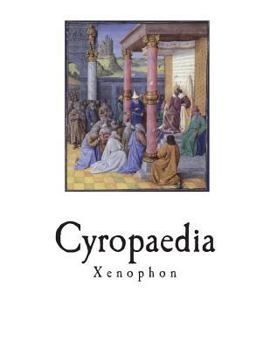
Cyropaedia: The Education of Cyrus


Select Format
Select Condition 
Book Overview
Cyropaedia: The Education of Cyrus by Xenophon and translated by H. G. Dakyns and revised by F. M. Stawell. A very few words may suffice by way of introduction to this translation of the Cyropaedia. Xenophon, it must be admitted, is not, like Plato, Thucydides, or Demosthenes, one of the greatest of Greek writers, but there are several considerations which should commend him to the general reader. He is more representative of the type of man whom the ordinary Englishman specially admires and respects, than any other of the Greek authors usually read. An Athenian of good social position, endowed with a gift of eloquence and of literary style, a pupil of Socrates, a distinguished soldier, an historian, an essayist, a sportsman, and a lover of the country, he represents a type of country gentleman greatly honoured in English life, and this should ensure a favourable reception for one of his chief works admirably rendered into idiomatic English. And the substance of the Cyropaedia, which is in fact a political romance, describing the education of the ideal ruler, trained to rule as a benevolent despot over his admiring and willing subjects, should add a further element of enjoyment for the reader of this famous book in its English garb. The Cyropaedia, sometimes spelled Cyropedia, is a largely fictional biography of Cyrus the Great the founder of Achaemenid Empire, the first Persian Empire. It was written around 370 BC by the Athenian gentleman-soldier, and student of Socrates, Xenophon of Athens. The Latinized title Cyropaedia derives from Greek Kurou paideia, meaning "The Education of Cyrus". Aspects of it would become a model for medieval writers of the genre known as mirrors for princes. In turn it was a strong influence upon the most well-known but atypical of these, Machiavelli's The Prince, which was an important influence in the rejection of medieval political thinking, and the development of modern politics. However, unlike most "mirrors of princes", and like The Prince, whether or not the Cyropaedia was really intended to describe an ideal ruler is a subject of debate.
Format:Paperback
Language:English
ISBN:1723584150
ISBN13:9781723584152
Release Date:July 2018
Publisher:Createspace Independent Publishing Platform
Length:164 Pages
Weight:0.87 lbs.
Dimensions:0.3" x 8.5" x 11.0"
Customer Reviews
4 ratings
Review of Ambler's Cyropaedia
Published by Thriftbooks.com User , 16 years ago
This translation is incredibly easy to read; I enjoyed it very much. My only complaint is that it uses endnotes rather than footnotes. Even so, the translation is so approachable that one can garner much from this work with little historical background. The introduction is interesting if a bit of a ramble.
In the name of Iran
Published by Thriftbooks.com User , 19 years ago
This book was indepth research of King of kings Cyrus the Great with respect how did He became the King of Persia/Iran. Interestingly, Cyrus the Great became the King of Iran not by having large army but by hard work, and relying on His good allies and friends to establish His empire. If English is your second language or if you are first time reader of Cyrus the Great you may wish to read this book "Xenophon's Cyrus The Great" by Larry HEDRICK in order to grasp King of kings Cyrus the Great very well. Ahura Mazda be with you.
Xenofreak
Published by Thriftbooks.com User , 20 years ago
This truly is one of the most remarkable books I've ever read and I would encourage anyone with an interest in military science, government or leadership to take the time to read it. This book requires commitment and a quiet place to read and savor its thought-provoking passages. The investment of time and effort is dwarfed by the magnitude of the lessons this book has to offer. Make the commitment and you'll see why this book was a favorite of men like Alexander the Great, Scipio Africanus, Caesar and Machiavelli.
A Brilliant Read
Published by Thriftbooks.com User , 23 years ago
Herodotus' Histories is often considered the gold standard of knowledge pertaining to the Persian empire. Little is made of the fact that this Ionian had certain political grudges against his political masters and had never visited Persia or had entry into Persian society. Xenophone however was a nobleman who lived amongst the Persians and the Medes and was acquaianted with their ways and histories. Xenophone's observations on Persian society and religion are far closer to modern scholarship than Herodotus. Furthermore even the chronological inaccuracies of Cyropaedia are in the Persian tradition. As evidenced by Sassanian histories, the Persians had the habit of attributing the conquests of dynasties to their founders. However the most fascinating and thrilling aspect of reading this book is that the educational stories attributed to Cyrus are identical to the stories found in Adab or the Persian courtly literature of Islamic era. Given that Xenophone was not translated into Persian or Arabic, this confirms the authenticity of the materials used by Xenophone. I love this book and have read it twice already. I recommend it to anyone who wants to have a closer look at the realities of Persia.
Copyright © 2026 Thriftbooks.com
Terms of Use | Privacy Policy | Do Not Sell/Share My Personal Information | Cookie Policy | Cookie Preferences | Accessibility Statement
ThriftBooks ® and the ThriftBooks ® logo are registered trademarks of Thrift Books Global, LLC
ThriftBooks ® and the ThriftBooks ® logo are registered trademarks of Thrift Books Global, LLC
