


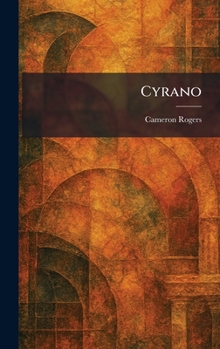
Cyrano

"Cyrano" by Cameron Rogers is a compelling and vivid biography of Savinien de Cyrano de Bergerac, the 17th-century French polymath whose life inspired Edmond Rostand's world-famous play. Far from being a mere fictional creation, the historical Cyrano was a soldier, a philosopher, a satirist, and a legendary duelist whose real-life exploits were as dramatic as any stage production. Rogers delves into the complexities of a man caught between the rigid structures of his era and his own fiercely independent spirit.
This work explores Cyrano's literary contributions, including his pioneering science fiction narratives and his sharp-witted critiques of society. Beyond the celebrated image of the romanticized tragic lover, the book examines his actual experiences on the battlefields of France and his intellectual pursuits in the salons of Paris. By stripping away the layers of legend, Rogers presents a humanizing portrait of a brilliant, often misunderstood figure whose wit and sword were equally sharp. "Cyrano" remains an essential read for those interested in French history, literary biography, and the true story behind one of literature's most enduring icons.
This work has been selected by scholars as being culturally important, and is part of the knowledge base of civilization as we know it. This work was reproduced from the original artifact, and remains as true to the original work as possible. Therefore, you may see the original copyright references, library stamps (as most of these works have been housed in our most important libraries around the world), and other notations in the work.
This work is in the public domain in the United States of America, and possibly other nations. Within the United States, you may freely copy and distribute this work, as no entity (individual or corporate) has a copyright on the body of the work.
As a reproduction of a historical artifact, this work may contain missing or blurred pages, poor pictures, errant marks, etc. Scholars believe, and we concur, that this work is important enough to be preserved, reproduced, and made generally available to the public. We appreciate your support of the preservation process, and thank you for being an important part of keeping this knowledge alive and relevant.
Customer Reviews
ThriftBooks ® and the ThriftBooks ® logo are registered trademarks of Thrift Books Global, LLC
