


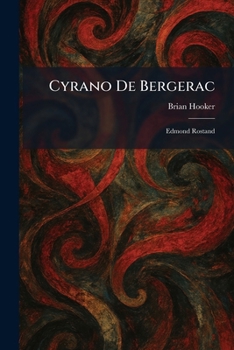
Cyrano De Bergerac: Edmond Rostand

"Cyrano De Bergerac" is a timeless masterpiece of French drama, written by Edmond Rostand and presented here in the celebrated English translation by Brian Hooker. Set in 17th-century France, the play follows the titular protagonist, a brilliant swordsman, philosopher, and poet with a formidable wit and an equally formidable nose. Despite his many talents and his courageous spirit, Cyrano is plagued by insecurity regarding his appearance, which prevents him from expressing his deep love for the beautiful and intellectual Roxane.
The story unfolds as a poignant exploration of unrequited love, sacrifice, and the concept of "panache." When Cyrano discovers that Roxane is infatuated with the handsome but dim-witted Christian de Neuvillette, he chooses to ghostwrite eloquent love letters and speeches for his rival, effectively wooing his own beloved through another man's voice. This classic work perfectly blends elements of swashbuckling adventure with profound romantic tragedy, examining the enduring tension between inner beauty and outward appearance. "Cyrano De Bergerac" remains one of the most celebrated plays in world literature, offering a heroic yet heart-wrenching portrait of a man who lives and dies for his honor and his heart's true desire.
This work has been selected by scholars as being culturally important, and is part of the knowledge base of civilization as we know it. This work was reproduced from the original artifact, and remains as true to the original work as possible. Therefore, you may see the original copyright references, library stamps (as most of these works have been housed in our most important libraries around the world), and other notations in the work.
This work is in the public domain in the United States of America, and possibly other nations. Within the United States, you may freely copy and distribute this work, as no entity (individual or corporate) has a copyright on the body of the work.
As a reproduction of a historical artifact, this work may contain missing or blurred pages, poor pictures, errant marks, etc. Scholars believe, and we concur, that this work is important enough to be preserved, reproduced, and made generally available to the public. We appreciate your support of the preservation process, and thank you for being an important part of keeping this knowledge alive and relevant.
Related Subjects
DramaCustomer Reviews
ThriftBooks ® and the ThriftBooks ® logo are registered trademarks of Thrift Books Global, LLC
