


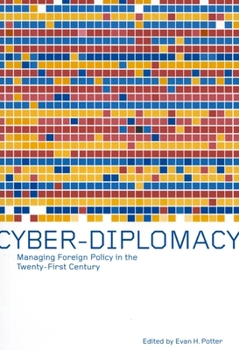
Cyber-Diplomacy: Managing Foreign Policy in the Twenty-First Century
No Customer Reviews

Mass communications and advances in communications technology pose fundamental challenges to the traditional conduct of diplomacy by reducing hierarchy, promoting transparency, crowding out secrecy, mobilizing global social movements, and increasing the importance of public diplomacy in international relations. But the primary source of change, the force that acts as a common denominator and accelerates other changes, is communications and information technology (CIT). Where nations were once connected through foreign ministries and traders, they are now linked to millions of individuals by fibre optics, satellite, wireless, and cable in a complex network without central control. These trends have resulted in considerable speculation about the future of diplomacy. Contributors include Andrew F. Cooper (University of Waterloo), Ronald J. Deibert (University of Toronto), Eytan Gilboa (Holon Institute of Technology and Bar-Ilan University, Israel), Steven Livingston (George Washington University), Evan H. Potter (Universty of Ottawa), Gordon Smith (University of Victoria), Peter J. Smith (Athabasca University), Elizabeth Smythe (Concordia University College of Alberta), and Allen Sutherland (Government of Canada).
Format:Paperback
Language:English
ISBN:0773524517
ISBN13:9780773524514
Release Date:September 2002
Publisher:McGill-Queen's University Press
Length:216 Pages
Weight:0.81 lbs.
Dimensions:0.6" x 6.1" x 9.0"
Customer Reviews
0 rating
Copyright © 2026 Thriftbooks.com
Terms of Use | Privacy Policy | Do Not Sell/Share My Personal Information | Cookie Notice | Cookie Preferences | Accessibility Statement
ThriftBooks ® and the ThriftBooks ® logo are registered trademarks of Thrift Books Global, LLC
ThriftBooks ® and the ThriftBooks ® logo are registered trademarks of Thrift Books Global, LLC
