


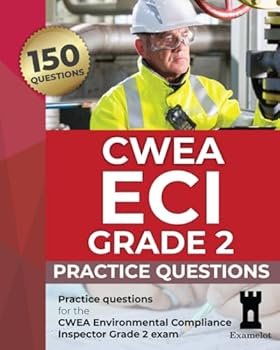
CWEA ECI Grade 2 Practice Questions: Practice questions for the CWEA Environmental Compliance Inspector Grade 2 exam
No Customer Reviews

CWEI ECI Grade 2 Practice Exam: Prepare for Success! Looking for an effective way to prepare for the CWEI Environmental Compliance Inspector (ECI) Grade 2 exam? This unofficial book contains 150 multiple-choice practice questions on the major topics of the CWEI ECI Grade 2 exam, including permit applications, self-monitoring reports, water treatment plant inspections, collection devices, field tests, communication, safety, and sewer impact fees. Each question is designed to closely resemble the types of questions you'll encounter on the actual exam, so you can practice with confidence and get a feel for the exam format. Answers to difficult questions are accompanied by explanations, allowing you to fully understand the reasoning behind the answer. Sample questions To give you an idea of the questions, below are six questions from the book. 1) If a vertical cylindrical tank has a diameter of 5 feet and a height of 8 feet, then what is the capacity of the tank in cubic feet? a. 145 b. 157 c. 227 d. 290 Answer: b) 157 Step 1) Calculate the radius of the tank First, find the radius of the tank. The question gives the tank's diameter as 5 feet, so the radius is 2.5 feet (half of 5). Step 2) Calculate the area of the base of the tank To find the area of a circle, we use the equation area = π × r². So the area of the base of the tank is π × 2.5² = 19.6. Step 3) Calculate the volume of the tank in cubic feet Volume of a cylinder = height × area of the circle = 8 × 19.6 = 157 cubic feet 2) Which of these is a source of dilute solutions that may be discharged to the pretreatment system or POTWs? a. Reject products b. Spent plating baths c. Static drag out solutions d. Stormwater runoff Answer: d) Stormwater runoff Stormwater runoff is precipitation (rain or snowmelt) that flows across the land. Stormwater runoff can contain various dilute pollutants like dirt, debris, fertilizers, pesticides, and oil residues from streets and parking lots. 3) What is 0.05 mL in microliters? a. 0.0005 μL b. 0.005 μL c. 5 μL d. 50 μL Answer: d) 50 μL To convert from milliliters to microliters, multiply the number by 1,000. So 0.05 milliliters in microliters = 0.05 × 1,000 = 50 microliters 4) What association is devoted to eliminating death and injury due to fire hazards? a. CWEA b. NFPA c. NSC d. OSHA Answer: b) NFPA The NFPA is the National Fire Protection Association. It is a non-profit organization devoted to eliminating death, injury, and property loss due to fire. 5) Which of these causes concrete to crack when it reacts with calcium? a. Sulfate b. Chloride c. Chlorine d. Nitrate Answer: a) Sulfate Sulfate reacts with calcium compounds in concrete, such as calcium hydroxide and calcium aluminate hydrate, forming expansive products like ettringite. This expansion can cause the concrete to crack and deteriorate. This process is called sulfate attack and is a common cause of concrete degradation in sulfate-rich environments. 6) If a water sample is not properly chilled and sealed, which of these water quality indicators would stay the same? a. BOD b. COD c. Dissolved sulfide d. Hardness Answer: d) Hardness If samples are not properly chilled and sealed, then BOD, COD, dissolved sulfide and pH can change. However, hardness would stay the same.
Format:Paperback
Language:English
ISBN:B0BJYSLHZS
ISBN13:9798359264747
Release Date:October 2022
Publisher:Independently published
Length:71 Pages
Weight:0.47 lbs.
Dimensions:10.0" x 0.2" x 8.0"
Customer Reviews
0 rating
Copyright © 2026 Thriftbooks.com Terms of Use
| Privacy Policy | Do Not
Sell/Share My Personal Information | Cookie Policy | Cookie Preferences | Accessibility Statement
ThriftBooks® and the ThriftBooks® logo are registered trademarks of Thrift Books Global, LLC
ThriftBooks® and the ThriftBooks® logo are registered trademarks of Thrift Books Global, LLC
