


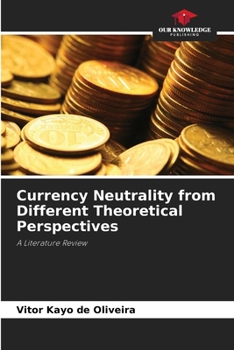
Currency Neutrality from Different Theoretical Perspectives
No Customer Reviews

In light of the diversity of interpretations of macroeconomic phenomena, this book reviews how different schools of economic thought present the theoretical relationship between money and real variables, especially aggregate output and the level of employment, against the backdrop of the search for the mechanisms that allow the manifestation of the neutrality or otherwise of money. To do this, the author maps out the modern history of macroeconomic thought and goes into greater depth to explain some of the mechanisms mentioned by Mollo (2004) that make it possible for money to be neutral or not and reflect the views of different schools of economic thought (neoclassical, monetarist, new-classical, new-Keynesian and post-Keynesian). In preparing the review, it draws on studies by commentators, in particular Snowdon and Vane (2005), as well as works belonging to each school. This book is aimed at scholars of the history of economic thought who seek to better understand the debate surrounding the question of the neutrality of money.
Format:Paperback
Language:English
ISBN:620852346X
ISBN13:9786208523466
Release Date:January 2025
Publisher:Our Knowledge Publishing
Length:56 Pages
Weight:0.21 lbs.
Dimensions:0.1" x 6.0" x 9.0"
Customer Reviews
0 rating
Copyright © 2026 Thriftbooks.com Terms of Use
| Privacy Policy | Do Not
Sell/Share My Personal Information | Cookie Policy | Cookie Preferences | Accessibility Statement
ThriftBooks® and the ThriftBooks® logo are registered trademarks of Thrift Books Global, LLC
ThriftBooks® and the ThriftBooks® logo are registered trademarks of Thrift Books Global, LLC
