


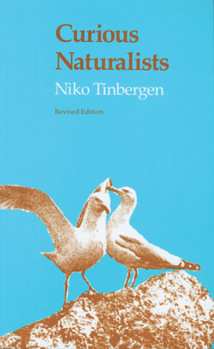
Curious Naturalists

Select Format
Select Condition 
Book Overview
Enthusiastic and informal accounts of the exciting discoveries and fascinating observations made by naturalists in the study of the behavior of animals in their natural surroundings.
Curious Naturalists is one of the most beloved and enduring works in the literature of natural history and animal behavior. Written by Nikolaas "Niko" Tinbergen--the Dutch-born ethologist who shared the 1973 Nobel Prize in Physiology or Medicine with Konrad Lorenz and Karl von Frisch for their foundational work in establishing the science of ethology--the book offers enthusiastic and informal accounts of the exciting discoveries and fascinating observations made by naturalists in the study of the behavior of animals in their natural surroundings.
First published in 1958, the book distills approximately 25 years of Tinbergen's fieldwork and biological exploration into vivid, accessible narratives written for a broad general audience. Tinbergen thought of himself above all as a "curious naturalist"--someone dedicated to watching and wondering about the natural world--and that spirit of patient, joyful inquiry permeates every page. The writing is notably free of technical jargon, making the science accessible to non-specialists while losing none of its intellectual depth.
The book draws on Tinbergen's own landmark field studies, including his celebrated investigations into the behavior of digger wasps and their remarkable ability to navigate back to their burrows using visual landmarks, experiments that became classics in the study of animal learning and spatial orientation. He also recounts studies of herring gulls, three-spined sticklebacks, grayling butterflies, and other animals, weaving together descriptions of the field conditions, the questions asked, and the ingenious experiments devised to answer them. The accounts span fieldwork conducted in the Netherlands, on the English coast, and in other locations across Europe, capturing both the excitement of discovery and the painstaking methodology behind it.
Throughout, Tinbergen conveys his deep conviction that careful, patient observation of animals in their natural environments, rather than only in the laboratory, is essential to truly understanding behavior. In doing so, the book serves both as a compelling introduction to ethology and as a passionate defense of naturalistic study as a scientific method.
Customer Reviews
Interesting
Buy This for Your Kid, Then Read It Yourself
A joy! Open yourself up to the world around you!
ThriftBooks ® and the ThriftBooks ® logo are registered trademarks of Thrift Books Global, LLC
