


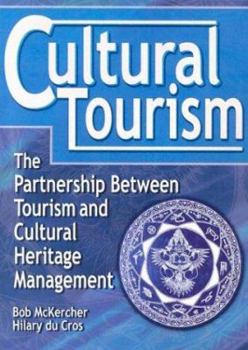
Cultural Tourism: The Partnership Between Tourism and Cultural Heritage Management

Select Format
Select Condition 
Book Overview
Examine cultural tourism issues from both sides of the industry Unique in concept and content, Cultural Tourism: The Partnership Between Tourism and Cultural Heritage Management examines the relationship between the sectors that represent opposite sides of the cultural tourism coin. While tourism professionals assess cultural assets for their profit potential, cultural heritage professionals judge the same assets for their intrinsic value. Sustainable cultural tourism can only occur when the two sides form a true partnership based on understanding and appreciation of each other's merits. The authors--one, a tourism specialist, the other, a cultural heritage management expert--present a model for a working partnership with mutual benefits, integrating management theory and practice from both disciplines.Cultural Tourism is the first book to combine the different perspectives of tourism management and cultural heritage management. It examines the role of tangible (physical evidence of culture) and intangible (continuing cultural practices, knowledge, and living experiences) heritage, describes the differences between cultural tourism products and cultural heritage assets, and develops a number of conceptual models, including a classification system for cultural tourists, indicators of tourism potential at cultural and heritage assets, and assessment criteria for cultural and heritage assets with tourism potential. Cultural Tourism examines the five main constituent elements involved in cultural tourism: cultural and heritage assets in tourism sites such as the Royal Palace in Bangkok, the Cook Islands, and Alcatraz Prison in San Francisco. tourism--what it is, how it works, and what makes it a success five different types of cultural tourists consumption of products, value adding, and commodification integrating the first four elements to satisfy the tourist, meet the needs of the tourism industry, and conserve the intrinsic value of the assetThough tourism and cultural heritage management professionals have mutual interests in the management, conservation, and presentation of cultural and heritage assets, the two sectors operate on parallel planes, maintaining an uneasy partnership with surprisingly little dialogue. Cultural Tourism provides professionals and students in each field with a better understanding of their own roles in the partnership, bridging the gap via sound planning, management, and marketing to produce top-quality, long-lasting cultural tourism products.
Now translated into simplified Chinese.
Now translated into simplified Chinese.
Format:Paperback
Language:English
ISBN:0789011069
ISBN13:9780789011060
Release Date:February 2002
Publisher:Routledge
Length:280 Pages
Weight:0.97 lbs.
Dimensions:0.6" x 5.9" x 8.3"
Customer Reviews
3 ratings
Cultural heritage tourism bible
Published by Thriftbooks.com User , 16 years ago
As a Phd student interested in cultural heritage tourism, I wish I had had this book two years ago. Unfortunately, it was not in the university library--but I eventually discovered it online and ordered a copy for myself--then got the library to order one, too. The book especially helped me appreciate and start to incorporate cultural heritage management ideas and principles into my research and writing. Both authors teach at Hong Kong Polytechnic University and have been working in the field of cultural tourism and/or management of heritage for 20 years. Reading this book is like taking a graduate level class from them personally! One tip: The hard copy is $170 and the paperback is around $45.
A great book!
Published by Thriftbooks.com User , 16 years ago
One of the best titles on cultural tourism: well structured, concise, lucid and documented with relevant examples. Nothing is too much here. The authors are focused on the main issues of the subject, which is dissected in a precise and coherent way. As a textbook it would gain a great popularity among students!
Cultural Tourism - Building a Partnership
Published by Thriftbooks.com User , 23 years ago
"Cultural Tourism - The Partnership Between Tourism and Cultural Heritage Management" presents a strong and well argued case for building a vital and productive partnership between two potentially competing interest groups. The book is an excellent and thorough disertation and expansion on the principles and guidelines contained in the "ICOMOS International Cultural Tourism Charter". ICOMOS is the international organisation that brings together all those who work in the field of historic building and site conservation. The protection and conservation of their historic buildings, sites and places is an important part of the cultural identity of every community. Presentation of the significant characteristics of these places to the public is essential if there is to be widespread support for their protection and conservation. The tourism industry plays an important part in this presentation process. Hilary and Bob have explored many of the ideas contained in the Charter, provided case studies and taken the work into new areas. As a result, I have no doubt that it will become one of the seminal texts related to the work of the ICOMOS International Cultural Tourism Committee, as it encourages productive linkages between toruism and cultural heritage management internationally. Hisashi Sugaya, former Chairman of the Committee notes that "the book identifies those factors that must be considered when evaluating the tourism potential of cultural or heritage assets, and presents a model for evaluating how to integrate tourism with cultural heritage management". Dr Walter Jamieson, a heritage tourism consultant working in South East Asia, notes that "the book is a very useful contribution to our understanding of maintaining our heritage within the context of tourism development". Graham BrooksChairmanICOMOS International Cultural Tourism Committee
Copyright © 2026 Thriftbooks.com Terms of Use
| Privacy Policy | Do Not
Sell/Share My Personal Information | Cookie Policy | Cookie Preferences | Accessibility Statement
ThriftBooks® and the ThriftBooks® logo are registered trademarks of Thrift Books Global, LLC
ThriftBooks® and the ThriftBooks® logo are registered trademarks of Thrift Books Global, LLC
