


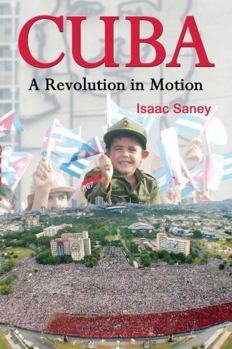
Cuba: A Revolution in Motion

Select Format
Select Condition 
Book Overview
This accessible, up-to-date and comprehensive introduction to modern Cuba provides an overview of Cuban history with particular emphasis on the country's post-Soviet economic collapse, the measures that President Castro's government took in response, and their ensuing results and impact.
This book neither paints Cuba as a perfect society nor universal model for Third World development. But it does argue that Cuba demonstrates that even relatively small countries can pursue a path of economic and social development that avoids the problems endemic in the rest of Latin America. The author also argues that the country's political stability is not merely the result of authoritarianism, but that important elements of democracy involve participation and help generate public support.
Cuba today continues to have huge problems, but the wider significance of the Cuban Revolution rests on its practical demonstration that it is possible to pursue radical and humane development policies which are at complete variance with the increasingly criticised nostrums of neoliberal economics being foisted on the rest of the world.
This book neither paints Cuba as a perfect society nor universal model for Third World development. But it does argue that Cuba demonstrates that even relatively small countries can pursue a path of economic and social development that avoids the problems endemic in the rest of Latin America. The author also argues that the country's political stability is not merely the result of authoritarianism, but that important elements of democracy involve participation and help generate public support.
Cuba today continues to have huge problems, but the wider significance of the Cuban Revolution rests on its practical demonstration that it is possible to pursue radical and humane development policies which are at complete variance with the increasingly criticised nostrums of neoliberal economics being foisted on the rest of the world.
Format:Paperback
Language:English
ISBN:1842773631
ISBN13:9781842773635
Release Date:February 2004
Publisher:Bloomsbury Publishing PLC
Length:240 Pages
Weight:0.80 lbs.
Dimensions:0.5" x 6.3" x 9.1"
Customer Reviews
5 ratings
Maybe big bad Cuba are not quite the evil commies our governement tries to paint them as...
Published by Thriftbooks.com User , 16 years ago
Great book and in my opinion it should be required reading for anyone who truly wants some insight into the situation in Cuba. I find it facinating to read about what Cuba was like before the revolution ("The American Mafia's whorehouse") and the great changes that have happened since those days thanks to heroes like Fidel and Che. Very insightful!
a must read if you care about Cuba
Published by Thriftbooks.com User , 16 years ago
After reading the negative reviews from the negative people I thought I better read this book. I could tell the one-star team didn't want people to actually read the book, and I wonder if they read it. No one book can tell you everything about a country or such a complex political situation, but this book is goes a long way in presenting ideas that are not generally expressed, especially in U.S. publications. This book is well written, interesting and has a valuable bibliography. By the way, Dalhousie University is not a "no name" college, as claimed by one of the negative reviewers. Dalhousie is consistently named among Canada's top research universities.
INSIGHTS INTO A DIFFERENT WORKING PARADIGM
Published by Thriftbooks.com User , 18 years ago
In this literary composition, brief yet comprehensive, Isaac Saney is making the case that: "The Cuban experience offers significant insights into not only a different paradigm, but a paradigm that has largely been successful--especially given the objective limitations of a small, poor, underdeveloped island nation--in utilizing the country's resources and wealth for the public good." Saney's work shows a deep understanding of history and the difficult, complex and contradictory process involved in the transformation of underdeveloped countries, from poverty and backwardness into more sustainable, developed and just societies. As he stated, "For Cubans, history has not yet met its `end'. The present is not detached from what has preceded it. This is the context that frames the oft-repeated slogan, `Socialism or death'..." Any attentive reader may point out that Saney's work appears to be too sympathetic to Cuba. Such a reader may have a valid point. Notwithstanding, the said alert, objective reader may also concede that the main argument presented in the book is carefully researched and presented. Although Saney resides in the high tower of academia, his writing style borders on down-to-earth journalistic. Not completely, but he has made the book comprehensible by the broadest cross-section of readers. "Cuba A Revolution in Motion" is a good book. I recommend it highly! The Black Jacobins: Toussaint L'Ouverture and the San Domingo Revolution In-Dependence from Bondage: Claude McKay and Michael Manley: Defying the Ideological Clash and Policy Gaps in African Diaspora Relations
all you ever wanted to know about Cuba
Published by Thriftbooks.com User , 21 years ago
This is the most complete, concise and thoughtful look at Cuba available in any media form. If you can only read one book about Cuba, this is it.
One of the most remarkable stories of our time
Published by Thriftbooks.com User , 21 years ago
"Cuba: A Revolution in Motion" by Isaac Saney offers a balanced, intelligent and highly accessible look at the current condition of the Cuban Revolution. Professor Saney's work shatters the mainstream caricature of Cuba as a nation that history has left behind. To the contrary, the author describes the dynamic and ongoing processes through which the Cuban people have struggled to achieve social justice. As Dr. Saney has demonstrated in this excellent book, the modern Cuban experience is without doubt one of the most remarkable stories of our time, offering insights about how humanity might secure a more peaceful, stable and liveable world.Dr. Saney is an Associate Director at Henson College, Dalhousie University in Canada. He is a frequent visitor to Cuba and conducts scholarly work in the fields of international development, political economy and law. The author is skilled at explaining Cuban political philosophy and helps us understand how the Cuban decision making process reflects the collectivist values of its society.The book has six chapters. The first is about the history of Cuba especially as it relates to slavery, U.S. economic dominance and Cuba's dependence on the Soviet Union. The so-called 'Special Period' that began as the result of the collapse of the U.S.S.R. is also covered in detail. Dr. Saney tells us that despite extreme economic hardship and mounting hostility from the U.S., the Revolution has been reaffirmed by the Cuban people. The author describes the many reforms that have been implemented in order to stabilize the economy and ensure that commitments to social justice remain intact for all its citizens. The second chapter discusses governance, perhaps one of the most misunderstood aspects of modern Cuban society. Dr. Saney states that the goal of the Cuban political system is to "extend democracy to both the political and economic spheres" by enshrining these rights in its constitution. In practice, free elections, unions and mass organizations allow for Cuban democracy to act as a force that shapes society from the bottom-up.Chapter three addresses race and inequality. Dr. Saney shows us how Cuba has transformed itself from a highly-stratified society to one of the most egalitarian in the world. The author contends that the Cuban state's eradication of the economic basis of racism offers proof that the "abolishment of the capitalist order [is] an indispensable step towards the elimination of racism".Chapter four is on the topic of crime and justice. Chapter five is about U.S. and Cuban history with an emphasis on recent events. While the Cuban justice system as described by Dr. Saney appears to compare favorably to most others in Latin America, ongoing U.S. hostility has meant that Cuba must make special provisions in its law to protect itself. If Cuba is to be castigated for punishing mercenaries, spies and other aggressors, then it is not unreasonable for the U.S. to cease its ongoing economic embargo, subversive activ
Copyright © 2026 Thriftbooks.com Terms of Use
| Privacy Policy | Do Not
Sell/Share My Personal Information | Cookie Policy | Cookie Preferences | Accessibility Statement
ThriftBooks® and the ThriftBooks® logo are registered trademarks of Thrift Books Global, LLC
ThriftBooks® and the ThriftBooks® logo are registered trademarks of Thrift Books Global, LLC
