


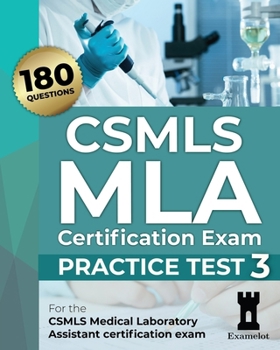
CSMLS MLA Certification Exam: Practice Test 3
No Customer Reviews

CSMLS MLA Certification Exam Practice Tests: Prepare for Success This is the third unofficial book of practice questions for the Canadian Society for Medical Laboratory Science (CSMLS) Medical Laboratory Assistant (MLA) exam. With a further 180 multiple-choice questions to practice with, this book comprehensively covers all major topics you'll encounter on the CSMLS MLA exam, including: Safe Work PracticesAnalytical ProceduresQuality ManagementCritical ThinkingAnd more Many questions come with detailed explanations, helping you fully understand the answers and the reasoning behind them. ABOUT THE SERIES
This is the third book in our series. For additional books in the series, visit amazon.ca/dp/B093TG1FDR. KEY FEATURES
Our questions are modeled after the real CSMLS MLA exam, encompassing eight core competency areas: Safe Work PracticesData and Specimen Collection and HandlingPre-analytical ProceduresReagent PreparationCommunication and InteractionQuality ManagementProfessional PracticeCritical ThinkingThis book is designed to mirror the actual CSMLS MLA certification exam, making it an ideal tool for preparation. ---SAMPLE QUESTIONS--- Here are five sample questions from the book: 1) SAFE WORK PRACTICES
Which of these is a good laboratory safety rule?
a. Leave a machine switched on when performing repairs
b. Use one hand to carry testing samples, not two
c. Wait until the end of the shift to clean up spills
d. Wear safety goggles when working with strong chemicals Answer: d. Wear safety goggles when working with strong chemicals
Explanation: The correct option is to wear safety goggles when working with strong chemicals. Safety goggles prevent chemical splashes from entering the eyes. 2) DATA AND SPECIMEN COLLECTION AND HANDLING
When should a "stat" glucose test be performed?
a. Immediately
b. Within 1 hour
c. 2 hours after the last meal
d. Within 4 hours Answer: a. Immediately
Explanation: All requisitions marked "stat" should be performed immediately. 3) PRE-ANALYTICAL PROCEDURES
What colour is the stopper of an SPS tube?
a. Green
b. Lavender
c. Pink
d. Yellow Answer: d. Yellow
Explanation: SPS tubes contain sodium polyanethol sulfonate as an anticoagulant. They have yellow tops and are used for blood culture tests. 4) REAGENT PREPARATION
What is the dilution factor 1/5 expressed as a dilution ratio?
a. 1:4
b. 1:5
c. 1:6
d. 5:1 Answer: a. 1:4
Explanation: The dilution ratio 1:4 and the dilution factor 1/5 are different ways of expressing the same concept.
- 1:4 means a ratio of 1 part solute to 4 parts solvent.
- 1/5 means the final volume of the solution is 5 times the volume of the solute. Adding 4 parts of solvent to 1 part of solute creates a 1/5 dilution.
Therefore, a 1/5 dilution factor and a 1:4 dilution ratio both create a solution with 1 part solute to 4 parts solvent. 5) COMMUNICATION AND INTERACTION
A phlebotomist is drawing blood from a young boy. The boy's mother is in the room, and she says she doesn't like the sight of blood. She looks pale and says she feels faint. What should the phlebotomist do?
a. Ignore the mother, because the focus should be on the child
b. Offer the mother a chair to sit in
c. Take the child's blood as quickly as possible to get it over with
d. Tell the mother not to worry Answer: b. Offer the mother a chair to sit in
Explanation: The mother is showing signs of faintness. Offering her a chair is the most appropriate action.
This is the third book in our series. For additional books in the series, visit amazon.ca/dp/B093TG1FDR. KEY FEATURES
Our questions are modeled after the real CSMLS MLA exam, encompassing eight core competency areas: Safe Work PracticesData and Specimen Collection and HandlingPre-analytical ProceduresReagent PreparationCommunication and InteractionQuality ManagementProfessional PracticeCritical ThinkingThis book is designed to mirror the actual CSMLS MLA certification exam, making it an ideal tool for preparation. ---SAMPLE QUESTIONS--- Here are five sample questions from the book: 1) SAFE WORK PRACTICES
Which of these is a good laboratory safety rule?
a. Leave a machine switched on when performing repairs
b. Use one hand to carry testing samples, not two
c. Wait until the end of the shift to clean up spills
d. Wear safety goggles when working with strong chemicals Answer: d. Wear safety goggles when working with strong chemicals
Explanation: The correct option is to wear safety goggles when working with strong chemicals. Safety goggles prevent chemical splashes from entering the eyes. 2) DATA AND SPECIMEN COLLECTION AND HANDLING
When should a "stat" glucose test be performed?
a. Immediately
b. Within 1 hour
c. 2 hours after the last meal
d. Within 4 hours Answer: a. Immediately
Explanation: All requisitions marked "stat" should be performed immediately. 3) PRE-ANALYTICAL PROCEDURES
What colour is the stopper of an SPS tube?
a. Green
b. Lavender
c. Pink
d. Yellow Answer: d. Yellow
Explanation: SPS tubes contain sodium polyanethol sulfonate as an anticoagulant. They have yellow tops and are used for blood culture tests. 4) REAGENT PREPARATION
What is the dilution factor 1/5 expressed as a dilution ratio?
a. 1:4
b. 1:5
c. 1:6
d. 5:1 Answer: a. 1:4
Explanation: The dilution ratio 1:4 and the dilution factor 1/5 are different ways of expressing the same concept.
- 1:4 means a ratio of 1 part solute to 4 parts solvent.
- 1/5 means the final volume of the solution is 5 times the volume of the solute. Adding 4 parts of solvent to 1 part of solute creates a 1/5 dilution.
Therefore, a 1/5 dilution factor and a 1:4 dilution ratio both create a solution with 1 part solute to 4 parts solvent. 5) COMMUNICATION AND INTERACTION
A phlebotomist is drawing blood from a young boy. The boy's mother is in the room, and she says she doesn't like the sight of blood. She looks pale and says she feels faint. What should the phlebotomist do?
a. Ignore the mother, because the focus should be on the child
b. Offer the mother a chair to sit in
c. Take the child's blood as quickly as possible to get it over with
d. Tell the mother not to worry Answer: b. Offer the mother a chair to sit in
Explanation: The mother is showing signs of faintness. Offering her a chair is the most appropriate action.
Format:Paperback
Language:English
ISBN:B093RP1BCX
ISBN13:9798745813467
Release Date:April 2021
Publisher:Independently Published
Length:106 Pages
Weight:0.50 lbs.
Dimensions:0.2" x 8.0" x 10.0"
Customer Reviews
0 rating
Copyright © 2026 Thriftbooks.com Terms of Use
| Privacy Policy | Do Not
Sell/Share My Personal Information | Cookie Policy | Cookie Preferences | Accessibility Statement
ThriftBooks® and the ThriftBooks® logo are registered trademarks of Thrift Books Global, LLC
ThriftBooks® and the ThriftBooks® logo are registered trademarks of Thrift Books Global, LLC
