


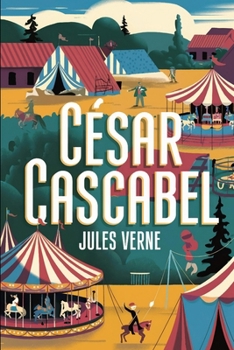
César Cascabel: A New Translation

A circus family. An impossible journey. And thousands of kilometers of Arctic wilderness between them and home.
The Cascabels-traveling circus performers in North America-dream of returning to France. When circumstances force them to attempt an overland route rather than sailing, they embark on an audacious odyssey: California through Alaska, across the Bering Strait to Siberia, then westward across the Russian Empire to Europe.
C sar Cascabel, the family patriarch, leads his troupe-wife Corn lia, children, fellow performers-through hostile terrain and countless dangers. Their circus skills occasionally prove useful (acrobatic abilities aid in physical challenges, performances earn money in settlements), but mostly they must rely on resourcefulness, courage, and family unity to survive the Arctic wilderness.
Jules Verne wrote C sar Cascabel in 1890, showcasing his geographical knowledge through extended travelogue spanning three continents. He researched Alaska (still relatively unknown to Europeans), the Bering Strait crossing, and Siberia's vast distances, using the family's journey as framework for geographical education.
Yet the novel reveals weaknesses increasingly evident in his middle-period work. The characterization is thin (family members defined by circus skills and family roles rather than complex psychology). The plotting is episodic and repetitive (encounter obstacle, overcome through ingenuity, face next obstacle). The treatment of indigenous peoples reflects colonial attitudes modern readers will find deeply problematic. And the considerable length creates pacing challenges as Verne sustains interest across hundreds of pages of similar terrain and similar challenges.
Contemporary critics recognized it as competent professional work while noting it lacked the imaginative spark of his science fiction and followed conventional adventure formulas without innovation.
Modern readers will find basic adventure entertainment and dated geographical information, but thin characterization, repetitive structure, and problematic cultural representations.
From the author of Twenty Thousand Leagues Under the Sea-competent middle-period adventure demonstrating geographical knowledge but lacking imaginative vision that made his science fiction revolutionary.
Customer Reviews
ThriftBooks ® and the ThriftBooks ® logo are registered trademarks of Thrift Books Global, LLC
