


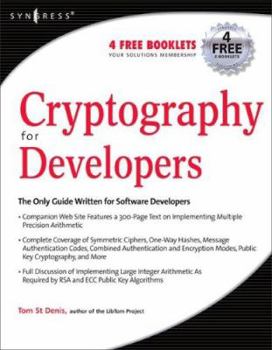
Cryptography for Developers


The only guide for software developers who must learn and implement cryptography safely and cost effectively. Cryptography for Developers begins with a chapter that introduces the subject of... This description may be from another edition of this product.
Format:Paperback
Language:English
ISBN:1597491047
ISBN13:9781597491044
Release Date:January 2007
Publisher:Syngress Publishing
Length:450 Pages
Weight:1.75 lbs.
Dimensions:1.3" x 7.1" x 8.9"
Customer Reviews
4 ratings
learning the cryptography
Published by Thriftbooks.com User , 15 years ago
This book is really good for who want to learn cryptography is ease to understand and there is the source code inside so you can understand how to implement it a crypto alghorithm i suggest this book for everyone want to lern how the crpto algo are working .
Good Software Cryptography Book
Published by Thriftbooks.com User , 18 years ago
With 'Cryptography for Developers' by Tom St Denis I am not even going to try and pretend that I am an expert in this field. Written with software developers in mind, this book is a complex look at how software cryptography algorithms are designed and developed. With 400 pages of material contained within and a solid look at the source content, this is a great book for a niche field/market. If you are interested in software cryptography or do it for a job, you will no doubt find this to be a fascinating read. **** RECOMMENDED
An excellent survey recommended for any college-level computer library.
Published by Thriftbooks.com User , 18 years ago
Cryptography for Developers deserves ongoing recommendation as a basic text - the only one written for software developers - probing the foundations of cryptography. Here are details covering message authentication codes, encryption models, public key cryptography, and more that discuss and provide examples of cryptographic goals and security measures. Any software developer serious about security must have this.
Well written, targets the saavy developer
Published by Thriftbooks.com User , 18 years ago
A lot of people who have read "Applied Cryptography" by BRuce Schneier are themselves not cryptographers or developing cryptographic software. In fact, very few people actually develop cryptographic software because it's tough to get right and most crypto libraries provide everything you need. However, for those that wish to enter the field, it can be daunting to learn. If you'd like to be one of those few, Tom St Denis' "Cryptography for Developers" may be for you. The book's writing is clear and focused, not surprising given that the author has written before. St Denis makes a good choice to focus on new material for this book, specifically pointing you at other books for a background in cryptography and "bignum" math (very, very large numbers, which require atypical methods to manipulate). If you're a C code developer, you'll get the material very well. If you're C isn't very strong, or you need the code for another language, you'll probably have some difficulty in making use of it (depending on how skilled you are with C). However, the code is clear and well annotated, so you can make pretty good sense of it pretty quickly. Chapter 2 starts off with a bang and covers ASN.1 encoding. This is not a very common topic, so this is one of the only places you may find this sort of thing covered well. Right away you can see what you're in for: very clear background info, good use of illustrations, well written code with lots of annotations, and very sharp focus. Chapter 3 covers random numbers (specifically RNGs and PRNGs). While you'll want to complement this with something like the CRC Applied Crypto chapters on random numbers, you'll get a pretty good idea of how to gather and make use of random numbers. One probem I noticed here was that notes that Yarrow and Fortuna are RNGs but later (and, I believe, correctly) states that they are PRNG algorithms. Overall, though, a good treatment of the topic and a discussion of where to use random numbers, how to test them, the limits of the tests, and what pitfalls to watch out for. Chapter 4 is really one of the meaty chapters and covers AES very in depth. Many of the concepts covered here are reused in other chapters, so make sure you get this one under your belt. Chapters 5 and 6 cover hash functions and message authentication code algorithms, respectively. Again, great treatment of a limited subset of the algorithms out there and very good discussions about the myths, truths, and appropriate uses of the algorithms. Very good, useful insights all around. Chapter 7 covers encryption and authentication modes, providing you with code that starts to really put it all together. Chapter 8 covers large integer arithmatic, but also states that it's no replacement for St Denis' other book on BigNum math. Another very useful topic covered here somewhat looks at optimizations and how to make efficient code. Again, valuable insights that you can apple to other topics. Chapter 9 covers public key algor
Copyright © 2025 Thriftbooks.com
Terms of Use | Privacy Policy | Do Not Sell/Share My Personal Information | Cookie Policy | Cookie Preferences | Accessibility Statement
ThriftBooks ® and the ThriftBooks ® logo are registered trademarks of Thrift Books Global, LLC
ThriftBooks ® and the ThriftBooks ® logo are registered trademarks of Thrift Books Global, LLC
