


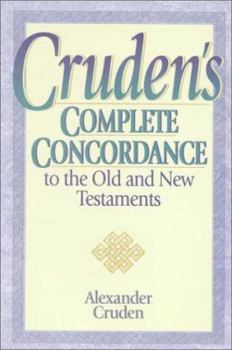
Cruden's Complete Concordance to the Old and New Testaments


Select Format
Select Condition 
Book Overview
Bible students have enjoyed Cruden's easy-to-use format and portable size for over 250 years. Available in both cloth and soft cover editions, this valuable reference is handy for fast word studies or... This description may be from another edition of this product.
Format:Hardcover
Language:English
ISBN:0917006313
ISBN13:9780917006319
Release Date:September 1988
Publisher:Hendrickson Publishers
Length:800 Pages
Weight:2.25 lbs.
Dimensions:1.8" x 6.4" x 8.6"
Age Range:12 years and up
Grade Range:Grade 7 and higher
Customer Reviews
5 ratings
Great for what it's meant for ...
Published by Thriftbooks.com User , 16 years ago
This little book is handy to have for travel or at convenient locations. I keep one at my desk at work. The one I recently bought, I bought for a friend who owned no concordance. I have never been able to not find what I was looking for with this book. It's not an exhaustive concordance, but it's good to have as an extra (lightweight and easy to take to a Bible study), or to give as a gift, or for beginning students of the word of God. The price is good for this handy reference book. I recommend it for the intents that I mentioned above. For a deeper study of the word of God, I recommend Strong's Exhaustive Concordance with the Hebrew and Greek dictionaries in the back of the book. God bless and guide your study of His word.
More for the Readers of scripture and for quick reference and travel
Published by Thriftbooks.com User , 17 years ago
Although I have both Strongs and Youngs concordances, this one is an excellent choice for your bible readings and research while either on the road or when you simply want to get quickly to the scripture you remember and wish to reference directly. What this has is so many variations of the scripture by word, and the quick short sentences or snippets of scripture will make it very easy for you to find what you are looking for. Although, the more words you remember from a scripture the better/quicker to find it. If you are not necessarily a researcher and/or someone giving messages or communicating the gist of scripture, this is an excellent reference work. If you wish to have the basic Hebrew or Greek words from which the English derives from then the above two mentioned reference works are best (athough there is a view that the Youngs and Strongs are strongly influenced away from the Koine Greek.) I just love the Crudens for when I travel, usually light weight and even in the complete edition, not so bulky as to take up too much space. A definate for any library where someone reads the Bible from time to time to the seriously studious who needs a quick look up.
Best Concordance ever
Published by Thriftbooks.com User , 18 years ago
I bought a Cruden's Concordance years ago and use it all the time. It is the best I have found yet. Then I decided to buy my friend and myself one to take to church with us so I ordered the compact version. I really love it and any word you want to look up in the bible is in there. Really nice!
An Excellent Reference Book of the Bible
Published by Thriftbooks.com User , 18 years ago
Note: Your "helpful" vote is appreciated. Thanks. My copy of "Cruden's Complete Concordance" has been well used over the decades. It should be updated into a larger format with larger print, but it is still a valuable work of some 800 pages. Any word found in the Bible can be easily located, including variations of the word. For example, there is a listing for "fatlings," "flatling," "fatness," "fats," and "fatted." Highly recommended along with: "The New Smith's Bible Dictionary." New Smith's Bible DictionaryNew Smith's Bible Dictionary
A Must Own!
Published by Thriftbooks.com User , 19 years ago
"Cruden's Compact Concordance" is a must own for those seeking to be genuine scripture scholars. It is small, user-friendly and easy to grab for quick word hunting. Just about all verses listing the particular desired word are presented as well as footnoted related ones for probing a possible better connection--extremely helpful if you are reading another Bible version. Most every day this book lands in my hand as I often need a verse and can't remember where to find it. Spy glasses might be necessitated for investigating the minuscule print, but this is the only drawback to this slim lining assist. My favorite recommended books are those that get people into the holy, immutable and inerrant Word. I also suggest the purchase of "Unger's Bible Dictionary" as an added comprehensive studious guide.
Copyright © 2026 Thriftbooks.com
Terms of Use | Privacy Policy | Do Not Sell/Share My Personal Information | Cookie Policy | Cookie Preferences | Accessibility Statement
ThriftBooks ® and the ThriftBooks ® logo are registered trademarks of Thrift Books Global, LLC
ThriftBooks ® and the ThriftBooks ® logo are registered trademarks of Thrift Books Global, LLC
