


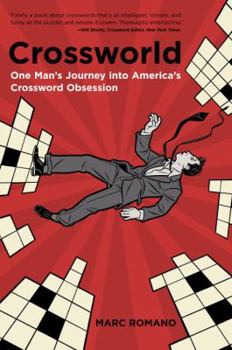
Crossworld: One Man's Journey into America's Crossword Obsession


Select Format
Select Condition 
Book Overview
Sixty-four million people do it at least once a week. Nabokov wrote about it. Bill Clinton even did it in the White House. The crossword puzzle has arguably been our national obsession since its birth... This description may be from another edition of this product.
Format:Hardcover
Language:English
ISBN:076791757X
ISBN13:9780767917575
Release Date:June 2005
Publisher:Broadway Books
Length:256 Pages
Weight:0.90 lbs.
Dimensions:8.4" x 0.8" x 5.8"
Customer Reviews
5 ratings
Decent Little Book About a Hobby (or Obsession)
Published by Thriftbooks.com User , 20 years ago
I found "Crossworld" to be an interesting look at the history, peculiarities and nuances of crossword puzzling and puzzlers. Centering around the annual competition in Connecticut, he brings in the right amount of Will Shortz, fellow puzzlers and constructors to provide an overview of the whole cross-world. As other reviewers note, author Marc Romano does interject himself into the book a lot - but I never thought he got in the way of telling the story he wanted to tell. One thing I notice about reviewers complaining Romano was a show-off with the words he used and his self-promotion is that they also like to display their vocabularies and knowledge in explaining how they dislike that in Romano.
If you know what an ESNE is?
Published by Thriftbooks.com User , 21 years ago
This is a light and amusing little book on the serious subject of crossword puzzles. I say serious, because anything done on a regular basis by 64 million people in the United States alone has to be considered pretty serious. And you'd better read it with a dictionary close by. Crossword people know lots of words, some of them pretty strange, and when they write their own book, they get to use them. While most of us have a hard time putting words like adit (an almost horizontal entrance to a mine), oryx (African antelope genus), ani (members of an American bird genus), esne (my dictionary didn't even have this one) into our working vocabulary. And of course these people at this level only have one crossword in mind, the one in the New York Times (four to ten minutes to finish, 16 on Sunday). I liked the story where someone asked him if he could have his paper when he was through with it. 'Yes,' he replied, 'but the puzzle is already done.' 'I know, I want to show people that the puzzle is done.' (In ink of course.) Are you looking for a gift for a puzzler?
An account of an enthusiast's adventures at the American Crossword Puzzle tournament
Published by Thriftbooks.com User , 21 years ago
To your list of important American inventions --- baseball, the electric light, polio vaccine, the electoral college --- please add the crossword puzzle. Since its invention by a New York City newspaperman in 1913, it has, with equal ease, entertained us and driven us utterly crazy. Marc Romano, a former Wall Street worker bee and newspaper reporter, himself got stung rather late in life by the crossword bug --- but being a resourceful fellow he has turned that fact to his advantage in this entertaining if lightweight book. CROSSWORLD chronicles his adventures among the Babe Ruths of puzzledom --- the contestants in the annual American Crossword Puzzle Tournament held each year in Stamford, CT. (Full disclosure: I share Romano's obsession. I have reached the finals in three of those tournaments and cherish one fourth-place trophy as a memento.) Romano attended one Stamford tournament as a reporter, then came back a second year as a contestant. A gregarious fellow, he kept eyes and ears open, got to know some of the right people, did some research, and has turned the whole experience into an enjoyable book. His writing has some of the breeziness of the experienced newspaper feature writer, though it can occasionally turn a tad smart-alecky. The tournament-day atmosphere of manic tense concentration relieved by bouts of shoptalk and hotel bar patronage is nicely captured. The main thing that differentiates these tournaments from your casual daily tussle with the crossword in your morning paper is, of course, the ticking clock. Most recreational solvers don't worry about how many minutes and seconds it takes them to fill in that grid, but at Stamford that is a major factor. Romano's advice, learned the hard way: worry first about accuracy, only then about the clock. The quirky personalities who turn up at these offbeat events are laid out in colorful detail. The reader gets an intimate look at Will Shortz, tournament director and the only man in the world, so far as anyone knows, who holds a college degree in "enigmatology" (his day job is editing the New York Times crosswords). Some of the more interesting characters among high-speed solvers make cameo appearances, but Romano's real interest appears to be in the people who create crosswords. This seems an odd move from the marketing standpoint, considering the millions of us who do the puzzles versus the couple of hundred who create them. Superior solvers, Romano finds, tend to be introverts, "introspective, solitary creatures" whose minds soak up and retain all sorts of trivia. Yet when they get together at the hotel bar in Stamford they somehow become a jolly crowd of fun-loving friends. He never quite explains how or why this transformation happens. My own experience at three of these events is that there are also a lot of very big egos on display and a good deal of one-upmanship in the shoptalk. These days, alas, even the humble crossword puzzle must take its turn on the analyst's couch
Enjoyable but too solipsistic
Published by Thriftbooks.com User , 21 years ago
As an avid crossworld solver, I was glad to read this book. It's not perfect -- Romano spends far too much time on himself, and particularly on his libido; I could have done without the "bedmate" story and all the ogling. It makes me wonder who his target audience is. But Romano's a clever writer, and it was nice to get some insight into New York Times crossword editor Will Shortz and superstar constructor Brendan Emmett Quigley. I have a stupid nitpick. On pages 69-70, Romano writes: "Like Judge Black's definition of pornography, you'll know these when you see them." There are three mistakes there. One, the famous quote was by Stewart, not Black. Two, it's "Justice," not "Judge." Three, the quote was about obscenity, not pornography (there's a difference). As another reviewer points out, it seems strange to see such errors in a book about people who supposedly pay such close attention to detail.
Ambassador's Masterpiece
Published by Thriftbooks.com User , 21 years ago
In America, unlike Britain, crosswords are usually viewed as a non-intellectual pastime. It is very rare to see someone from the world of high intellectual culture voice a favorable, let alone a knowledgeable, opinion on the subject. Marc Romano is such a person. A Yale graduate and (even more impressive) a former New York Review of Books staffer, he serves as an ambassador between the two worlds. As such, he entered the American Crossword Puzzle Tournament (the word puzzler's equivalent of the Super Bowl) and covered the event from every angle. Rare among puzzle aficionados, he is an admirer of Nabokov and Solzhenitsyn, Conrad and Gravity's Rainbow, and brings them to bear on the world of symmetrical word grids. Few aspects of puzzledom escape his attention, from ancient Cretan word-square artifacts, to the question of whether the tournament is imbued with sexual energy (an idea I have never seen in print before), to the contents of Will Shortz' house. And he is funny! I laughed out loud at least 10 times before finishing the book on the day I bought it. My only criticisms are: 1. He should have spent more time on the National Puzzlers' League and its journal, the Enigma (a fascinating world in its own right). 2. He should have talked about the difference between regular and variety cryptic puzzles, the American and British variants of both, and the British levels of difficulty beyond the Daily Telegraph (e.g., the Listener puzzle). However, in sum, the best book I have seen on word puzzling. Highly recommended.
Copyright © 2026 Thriftbooks.com
Terms of Use | Privacy Policy | Do Not Sell/Share My Personal Information | Cookie Policy | Cookie Preferences | Accessibility Statement
ThriftBooks ® and the ThriftBooks ® logo are registered trademarks of Thrift Books Global, LLC
ThriftBooks ® and the ThriftBooks ® logo are registered trademarks of Thrift Books Global, LLC
