


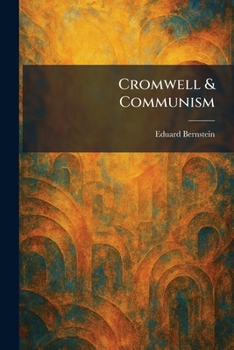
Cromwell & Communism

Select Format
Select Condition 
Book Overview
"Cromwell & Communism" is a seminal study of the social and democratic movements that emerged during the English Revolution. Written by the influential political theorist Eduard Bernstein, this work delves into the radical undercurrents of the 17th century, examining the rise of groups such as the Levellers and the Diggers. Bernstein provides a meticulous analysis of the struggle for social justice and economic equality amidst the political upheaval of the Commonwealth period.
The book focuses on the intellectual and social contributions of figures like Gerrard Winstanley and John Lilburne, illustrating how their proto-socialist ideas challenged the established order. By situating these movements within the broader context of Oliver Cromwell's rule, Bernstein explores the tension between revolutionary aspirations and the practical realities of governance. This work is essential for readers interested in the origins of modern political thought, the history of socialism, and the complex social dynamics of the British Isles during a time of fundamental change. Through its rigorous examination of historical events, "Cromwell & Communism" remains a foundational text for understanding the early intersections of democracy and collective ownership.
This work has been selected by scholars as being culturally important, and is part of the knowledge base of civilization as we know it. This work was reproduced from the original artifact, and remains as true to the original work as possible. Therefore, you may see the original copyright references, library stamps (as most of these works have been housed in our most important libraries around the world), and other notations in the work.
This work is in the public domain in the United States of America, and possibly other nations. Within the United States, you may freely copy and distribute this work, as no entity (individual or corporate) has a copyright on the body of the work.
As a reproduction of a historical artifact, this work may contain missing or blurred pages, poor pictures, errant marks, etc. Scholars believe, and we concur, that this work is important enough to be preserved, reproduced, and made generally available to the public. We appreciate your support of the preservation process, and thank you for being an important part of keeping this knowledge alive and relevant.
Customer Reviews
ThriftBooks ® and the ThriftBooks ® logo are registered trademarks of Thrift Books Global, LLC
