


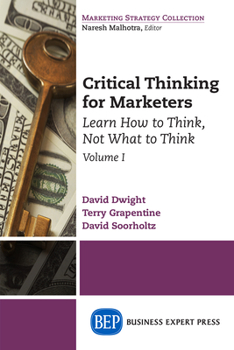
Critical Thinking for Marketers, Volume I: Learn How to Think, Not What to Think
No Customer Reviews

All marketing actions, whether preceded by formal or informal decision-making processes, are based on what philosophers call "arguments." An argument is a set of related statements comprising premises and a conclusion. Ideally, premises give an audience good reasons for accepting your argument's conclusion. In marketing, these "conclusions" are normative decisions about what an organization should do, for example, raise prices by five percent, add a new sales territory or, perhaps, change the marketing communications mix to invest more in digital and less in print. The premises are the rationale behind why the organization should take such actions. Critical Thinking for Marketers: Learn How to Think, Not What to Think provides information and guidelines on not only how to develop good arguments, but also what it means to develop a good argument. For example, the book describes two basic kinds of arguments-deductive and inductive-and how to examine whether such arguments are "good" or not. To do this, the book explains 60 logical fallacies-or errors in reasoning-that marketers should avoid. Additionally, the authors' several "Think Better" discussions examine how fields such as philosophy, behavioral economics, and marketing theory have informed the principles of critical thinking in marketing.
Format:Paperback
Language:English
ISBN:1631571168
ISBN13:9781631571169
Release Date:December 2016
Publisher:Business Expert Press
Length:184 Pages
Weight:5.70 lbs.
Dimensions:0.4" x 6.0" x 9.0"
Customer Reviews
0 rating
Copyright © 2026 Thriftbooks.com Terms of Use
| Privacy Policy | Do Not
Sell/Share My Personal Information | Cookie Policy | Cookie Preferences | Accessibility Statement
ThriftBooks® and the ThriftBooks® logo are registered trademarks of Thrift Books Global, LLC
ThriftBooks® and the ThriftBooks® logo are registered trademarks of Thrift Books Global, LLC
