


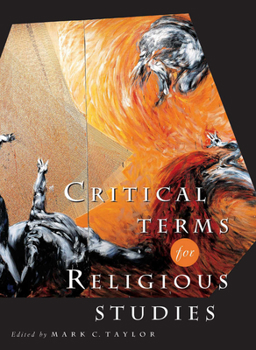
Critical Terms for Religious Studies


Select Format
Select Condition 
Book Overview
A century that began with modernism sweeping across Europe is ending with a remarkable resurgence of religious beliefs and practices throughout the world. Wherever one looks today, from headlines about political turmoil in the Middle East to pop music and videos, one cannot escape the pivotal role of religious beliefs and practices in shaping selves, societies, and cultures. Following in the very successful tradition of Critical Terms for Literary Studies and Critical Terms for Art History, this book attempts to provide a revitalized, self-aware vocabulary with which this bewildering religious diversity can be accurately described and responsibly discussed. Leading scholars working in a variety of traditions demonstrate through their incisive discussions that even our most basic terms for understanding religion are not neutral but carry specific historical and conceptual freight. These essays adopt the approach that has won this book's predecessors such widespread acclaim: each provides a concise history of a critical term, explores the issues raised by the term, and puts the term to use in an analysis of a religious work, practice, or event. Moving across Judaism, Christianity, Hinduism, Buddhism, Islam, and Native American and Mayan religions, contributors explore terms ranging from experience, territory, and image, to God, sacrifice, and transgression. The result is an essential reference that will reshape the field of religious studies and transform the way in which religion is understood by scholars from all disciplines, including anthropology, sociology, psychology, cultural studies, gender studies, and literary studies.
Format:Paperback
Language:English
ISBN:0226791572
ISBN13:9780226791579
Release Date:August 1998
Publisher:University of Chicago Press
Length:430 Pages
Weight:1.48 lbs.
Dimensions:0.9" x 6.9" x 9.3"
Related Subjects
Education & Reference Humanities Religion Religion & Spirituality Religious StudiesCustomer Reviews
2 ratings
Critical Terms for Religious Studies
Published by Thriftbooks.com User , 17 years ago
There is really not that much to "review" in a book that is itself a kind of review of the science of religion. The book is well written, with each chapter being assigned to an expert in that specific field of study. The book covers most subjects that are connected to religion in some way or the other, but sadly more or less the entire book is written from a typical liberal perspective, so big issues such as economy or race are not touched upon at all, but on the other hand we get more than our share on "liberation" and "gender". Apart from the introduction by the editor M. Taylor, the book contains these chapters; "Belief", "Body", "Conflict", "Culture", "Experience", "Gender", "God", "Image", "Liberation", "Modernity", "Performance", "Person", "Rationality", "Relic", "Religion, Religions, Religious", "Sacrifice", "Territory", "Time", "Transformation", "Transgression", "Value" and "Writing". The book itself is a fine book for any student of low to mid level studies, but by the time you have studied religion for more than a year, you should know most of the information in the book. The book contains some interesting passages as well, on page 130 Daniel Boyarin writes with a poison tongue for certain people; "[...]even the body of the radical constructionist theorist who claims that "she" "has" no vagina could presumably give birth." Sure made me laugh. An interesting and appealing idea I had not really thought of, is God as the watchmaker of the World. Fiorenza and Kaufman writes on page 146; "God was often pictured as a watchmaker: once the watch is made, it runs according to its own mechanisms". And to show just how absurd this popular academic "method" known as "critical studies" has become, a quote on page 210 from a certain Wilfred Smith; "what theology is to the Christian Church, a ritual dance may be to an African tribe." In other words, Meister Eckhart's thinking is no different than the dancing of a Congoid in the jungles of Africa. I assume most people will see that as just as absurd as I do. All in all, a fine book, but very partial (as most books are in this field, of course) and not of much use to higher level students. 4 stars.
An insightful introduction to critical religious studies.
Published by Thriftbooks.com User , 27 years ago
Critical Terms for Religious Studies is a wonderful introduction to religious studies. It uses interesting examples drawn from a wide range of religions to make its points clear. Topics are drawn from both obviously religious terminology, such as belief and God, to seemingly non-religious terms, such as culture and experience. The result is a deeply insightful book that gives the beginning student a lay of the religious studies landscape.
Copyright © 2026 Thriftbooks.com
Terms of Use | Privacy Policy | Do Not Sell/Share My Personal Information | Cookie Policy | Cookie Preferences | Accessibility Statement
ThriftBooks ® and the ThriftBooks ® logo are registered trademarks of Thrift Books Global, LLC
ThriftBooks ® and the ThriftBooks ® logo are registered trademarks of Thrift Books Global, LLC
