


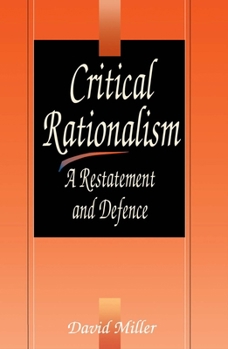
Critical Rationalism

Select Format
Select Condition 
Book Overview
Critical Rationalism, Popper's revolutionary approach to epistemology and scientific method, conceives human knowledge as consisting of unsupported guesses or conjectures. Investigation is therefore concerned, not with conclusively justifying our ideas - a hopeless endeavor - but with inventing new unjustified ideas and ejecting faulty ideas from the corpus of knowledge by criticism and refutation. The critical rationalist approach has been attacked by those who contend that it is little better than pure skepticism or irrationalism, or that it surreptitiously smuggles in the notion of inductive support. David Miller elegantly and provocatively reformulates critical rationalism by answering all its important critics. He presents a full defence of Popper's solution to the problem of induction, especially in the form which relates to practical decision-making. All known attempts to impeach Popper's solution as skeptical, irrationalist, or implicitly inductivist, are carefully considered and refuted. Critical Rationalism includes a detailed discussion of the role of probability in scientific method. Dr. Miller critically dissects the claims of Bayesianism, argues that objective probabilities do exist in the world, and proposes a new objectivist interpretation that makes sense of objective single-case probabilities even in a deterministic universe.
Format:Paperback
Language:English
ISBN:0812691989
ISBN13:9780812691986
Release Date:December 1998
Publisher:Open Court
Length:277 Pages
Weight:1.00 lbs.
Dimensions:0.7" x 6.0" x 8.9"
Customer Reviews
2 ratings
Induction Baaad! Falsification Goooood!
Published by Thriftbooks.com User , 20 years ago
In 1934 Karl Popper published "The Logic of Scientific Discovery" and a solution proposed a solution to David's Hume's problem of induction. Now called "Critical Rationalism" (CR), Popper did away with the problem be denying Science uses induction to find truth. He's tells Scientific knowledge grows by proposing brash new theories that can be tested, followed then by ruthlessly submitting them to severe tests an attempt to falsify them. Whatever survives with each iteration, brings us closer to truth. Instantly controversial, outraged induction-apologists and Popper supporters fired many heated words back and forth for years. Dave Miller eases the reader in to the controversy by the problem of induction, a short summary of other attempts to solve the problem and their shortcomings, and how Popper's falsification has solved it. Two whole chapters are devoted to Bayesian theory and how underwhelming is its utility to scientific activity. Miller corrects Popper's formulation of verisimilitude and clarifies propensity theory. Not a book for a beginner, but very satisfying. After you have enjoyed this book, you should read David Miller's new book "Out of Error" to see how Critical Rationalism has evolved.
Not bad
Published by Thriftbooks.com User , 26 years ago
I felt that the book explains the key issues well in a clear, well presented format. It is true that the book is not designed for the beginner but with a little knowledge it comes across beautifully.
Copyright © 2026 Thriftbooks.com
Terms of Use | Privacy Policy | Do Not Sell/Share My Personal Information | Cookie Policy | Cookie Preferences | Accessibility Statement
ThriftBooks ® and the ThriftBooks ® logo are registered trademarks of Thrift Books Global, LLC
ThriftBooks ® and the ThriftBooks ® logo are registered trademarks of Thrift Books Global, LLC
