


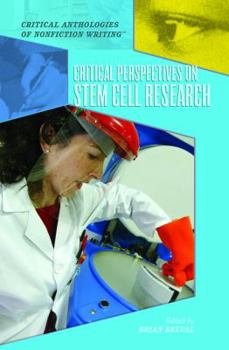
Critical Perspectives on Stem Cell Research

One of the most controversial issues of today, embryonic stem cell research reflects the schism between those who believe stem cells can be used to treat diseases, and others who object to stem cell research on moral and religious grounds. Each facet of the issue of stem cells, be it political, religious, scientific, or economic is explored, from the state to the global levels. These insightful, academia-worthy articles provide a balance of opinions on each side of the issues, allowing readers to form their own intelligent opinions about stem cell research.
Format:Library Binding
Language:English
ISBN:1404205403
ISBN13:9781404205406
Release Date:January 2006
Publisher:Rosen Young Adult
Length:176 Pages
Weight:0.76 lbs.
Dimensions:0.7" x 5.7" x 8.9"
Age Range:12 to 17 years
Grade Range:Grades 7 to 12
Customer Reviews
1 rating
Adult Stem cell hold the potential for solving many disease but not cancer.
Published by Thriftbooks.com User , 17 years ago
1. James A. Thomson of University of Wisconsin discovered human embryonic stem cells. Thomson was the first to isolate an embryonic stem cell line. Thomson also created a strategy to find monkey ES cells. 2. Evan Synder reported isolation of human neural stem cells. In his experiment, Synder injected the neural stem cells into the brains of newborn mice and confirmed that the cells develop into neurons and glia, the two major classes of brain cells. 3. One way to determine if an ES is pluripotent is mark them and inject them into an animal when it is born. If the marked cells turn up in all its tissues, the cell line is deemed pluripotent. 4. Could ES cells be injected in the region of the body desired to regenerate? No. The ES cells might form a teratoma or could differentiate into an undesirable tissue type, or both. In animal experiments, a teratoma containing fully formed teeth have been reported. To reduce risk, ES cells can be coxed into progenitor-cell stage before being administered to avoid undifferentiation of unwanted cell types. 5. ES cells and their derivatives carry the same likelihood of immune rejection as a transplanted organ because they carry antigens by which the immune system recognizes as invaders. 6. The problem with ES cell reject the immune system can be solved by using the patient's own genetic material through nuclear transfer. 7. The body is made of 200 kinds of cells. Once a cell is committed to a certain type there is no going back. Using somatic cell nuclear transfer scientist injected ES stem cells into heart scar tissue and within a month 38 percent of the tissue was healthy. SCNT is particular promising in cloning. In SCNT the nucleus is fused with denucleated human egg cell and placed in a surrogate mother. Woo Suk Hwantg proved that SCNT could work with primates. The Korean team create a human embryo through SCNT, grew it into a blastocyst and derived a pluripotent ES cell line. 8. ES cells derived by nuclear transfer are equivalent to regular ES cells. 9. German TOPCARE-AMI study patients with severe heart damage following myocardial infarction. The patients own heat progenitor cells were infused directly into the infracted artery. Four months later the size of the damaged tissue had decreased nearly 36 percent. 10. In bone marrow, stem cells are rare as one in 10,000 and in tissues there is no predictable location of the stem cells. 11. Once isolated, adult stem cells are slow and labor intensive to grow. There are many types of adult stem cells, each capable of repairing tissue they are to become. Scientist have only found a limit number of adult stem cells, and some organs have no stem cells after they are fully developed, meaning the adult stem cell could not be used to treat the organ. Some scientist argued the adult stem cell could differentiate itself into different types of cells types upon arrival at the damaged tissue; for example, bone marrow stem cells repairing heart muscle, brain, and l
Copyright © 2026 Thriftbooks.com
Terms of Use | Privacy Policy | Do Not Sell/Share My Personal Information | Cookie Policy | Cookie Preferences | Accessibility Statement
ThriftBooks ® and the ThriftBooks ® logo are registered trademarks of Thrift Books Global, LLC
ThriftBooks ® and the ThriftBooks ® logo are registered trademarks of Thrift Books Global, LLC
