


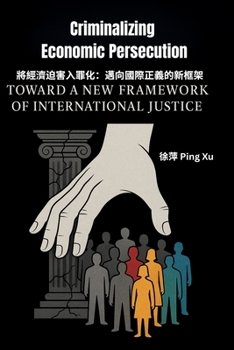
Criminalizing Economic Persecution: Toward a New Framework of International Justice

Criminalizing Economic Persecution is a groundbreaking call to expand the boundaries of international law.
While the world has recognized slavery, apartheid, and genocide as crimes against humanity, millions today still suffer under a quieter but equally devastating force: economic persecution. Families are evicted because housing is commodified, patients die when healthcare is denied, and hunger spreads when food is treated as a profit margin. These are not accidents of markets-they are deliberate choices embedded in policies and institutions.
This book argues that it is time for the global community to recognize economic persecution as a crime, enforce accountability, and build systems of universal care. Drawing on decades of frontline experience as a court interpreter in the United States, and with over fifty published works on housing, social protection, and universal basic income, Ping Xu makes complex legal and economic concepts accessible through vivid real-life examples.
Through rigorous legal analysis and moral clarity, Xu calls for a new international framework that treats systemic deprivation not as collateral damage, but as crime. She outlines a comprehensive roadmap-redefining sovereignty, strengthening enforcement mechanisms, transforming education and media, and building global alliances to end economic persecution.
Just as slavery and apartheid were once defended as "inevitable" until they ended, economic persecution too can-and must-be abolished.
Criminalizing Economic Persecution is not just a book. It is the beginning of a movement.
Customer Reviews
ThriftBooks ® and the ThriftBooks ® logo are registered trademarks of Thrift Books Global, LLC
