


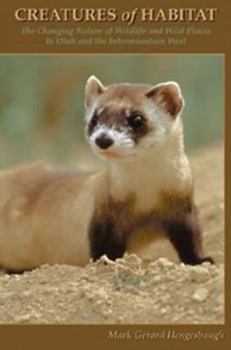
Creatures of Habitat: The Changing Nature of Wildlife and Wild Places in Utah and the Intermountain West


Select Format
Select Condition 
Book Overview
From flying squirrels on high wooded plateaus to hanging gardens in redrock canyons, the Intermountain West is home to some of the world's rarest and most fascinating animals and plants. Creatures of Habitat details many unique but little-known talents of this region's strange and wonderful wild inhabitants and descibes their connections with native environments. For example, readers will learn about the pronghorn antelope's supercharged cardiovascular system, a brine shrimp-powered shorebird that each year flies nonstop from the Great Salt Lake to Central Argentina, and a rare mustard plant recently discovered on Mount Ogden. Emphasizing how increasing loss and degradation of habitat hinders native species' survival, Mark Gerard Hengesbaugh discusses what is happening to wildlife and wild places and what is being done about it. Well illustrated, this book has habitat maps, pen-and-ink illustrations, and fifty photos of wildlife and wild places selected by photo editor Dan Miller. Also included are guides to wildlife viewing and lists of Utah species, including those considered sensitive, threatened, or endangered.
Format:Paperback
Language:English
ISBN:0874214173
ISBN13:9780874214178
Release Date:May 2001
Publisher:Utah State University Press
Length:256 Pages
Weight:0.65 lbs.
Dimensions:0.6" x 6.1" x 9.3"
Grade Range:Postsecondary and higher
Related Subjects
Animals Biological Sciences Conservation Ecology Fauna Nature Nature & Ecology Plants WildlifeCustomer Reviews
3 ratings
Great information, with interviews and issues galore!
Published by Thriftbooks.com User , 16 years ago
What affects the abundance and distribution of our wild creatures? Invasive species, over-exploitation, and habitat loss and fragmentation... these affect wildlife populations globally and locally. Author Mark Hengesbaugh, in Creatures of Habitat, looks at regional species and the factors that affect their persistence. Chapters include: 1. Animal life on the edge: does it take a special breed? 2. Endangered animal communities: the keystone concept 3. Historic herds: reintroducing native large animals 4. Alpine plants and animals: hardy inhabitants of Utah's high country 5. Great Basin birds: frequent flyers at Utah's busiest airport 6. Island syndrome extinctions: how small an area is too small for nature to carry on? 7. Aliens have landed! Weeds take over habitat 8. Western hydro-logic floods critical wildlife habitat 9. Can Utah's golf courses go green? 10. Transforming the Wasatch Mountains into an amusement park 11. The legacy of predator control 12. Decline of hunting leaves habitat hurting 13. The Nature Conservancy of Utah: wheeling and dealing in race with extinction 14. Birdwatching in the Beehive State: its popularity soars 15. Watching wildlife in wild places 16. The blame game: whose responsibility is habitat loss? There are also appendices of Utah species and places to go to view wildlife. Hengesbaugh doesn't just describe these species and the places they inhabit, he interviews the very people who are involved in studying, managing, or protecting these "resources". He really takes a broad view of conversation strategies, from hunting to protected areas to litigation, as long as they abide by the Leopoldian mantra: "A thing is right when it tends to preserve the integrity, stability and beauty of the biotic community. It is wrong when it tends otherwise."
Openly discusses what is happening to this wildlife
Published by Thriftbooks.com User , 24 years ago
Creatures Of Habitat: The Changing Nature Of Wildlife And Wild Places In Utah And The Intermountain West is an illustrated, exhaustively detailed account of the extremely fascinating animals and plants to be found in the Utah and the intermountain west, ranging from the shorebird that eats brine shrimp and flies nonstop each year from the Great Salt Lake to central Argentina, to the rare mustard plant just recently discovered on Mount Ogden. Creatures Of Habitat openly discusses what is happening to this wildlife and its natural surroundings, emphasizing how the loss of its habitat is contributing to the decline and extinction of numerous species. With lists, guides to wildlife viewing, and habitat maps, Creatures Of Habitat is an excellent reference for any amateur animal watcher or natural world armchair traveler, particularly those who live in or near Utah!
Where are we heading? The choice is ours.
Published by Thriftbooks.com User , 24 years ago
Development is overtaking both habitable places in the Intermountain West. The general wealth of our society, the inherited fortunes of the world war generation, and the achievements of technology, allow urban areas to expand across the habitable landscape. Growth in the urban footprint, along with that of the supporting technological and recreational infrastructure, results in habitat loss. In turn, several Utah species are becoming extinct. This book looks at the creatures at risk and the choices that have resulted in their becoming endangered. The reader learns that each sub division, road, strip mall, and power plant that is built to support our lives takes away precious habitat. The wild species that lived in that territory are not displaced. They may become endangered if the habitat loss is substantial. The burden of preservation is ours. The creatures endangered species cannot choose where to live. We must choose what to develop for ourselves and for them. "Creatures of Habitat" is divided into three major sections. It addresses endangered species, loss of wild places, and the choices we have for the future. The technical material is presented to tell the stories of how and why certain species are endangered. The story of each creature deserves to be heard. The book examines habitat loss issues from many angles, connecting these into a coherent picture of the complex problem of western development. There are several suggestions for becoming involved as individuals or in organizations dedicated to saving what remains of our wild places. I found the book to be unprejudiced and well researched. Problems are stated along with the history and present solutions, as are the behind-the-scenes groups that have been working to preserve habitat for years. There are probably surprises for readers who have not examined endangered species and habitat loss issues from all sides. In particular, I was pleased with the recognition that the hunter, and associated organizations, have worked to preserve habitat years before it became a well-known problem. This book is shows us that there are no easy solutions to these problems. Perhaps the greatest hope is in education. This book does just that.
Copyright © 2026 Thriftbooks.com Terms of Use
| Privacy Policy | Do Not
Sell/Share My Personal Information | Cookie Policy | Cookie Preferences | Accessibility Statement
ThriftBooks® and the ThriftBooks® logo are registered trademarks of Thrift Books Global, LLC
ThriftBooks® and the ThriftBooks® logo are registered trademarks of Thrift Books Global, LLC
